
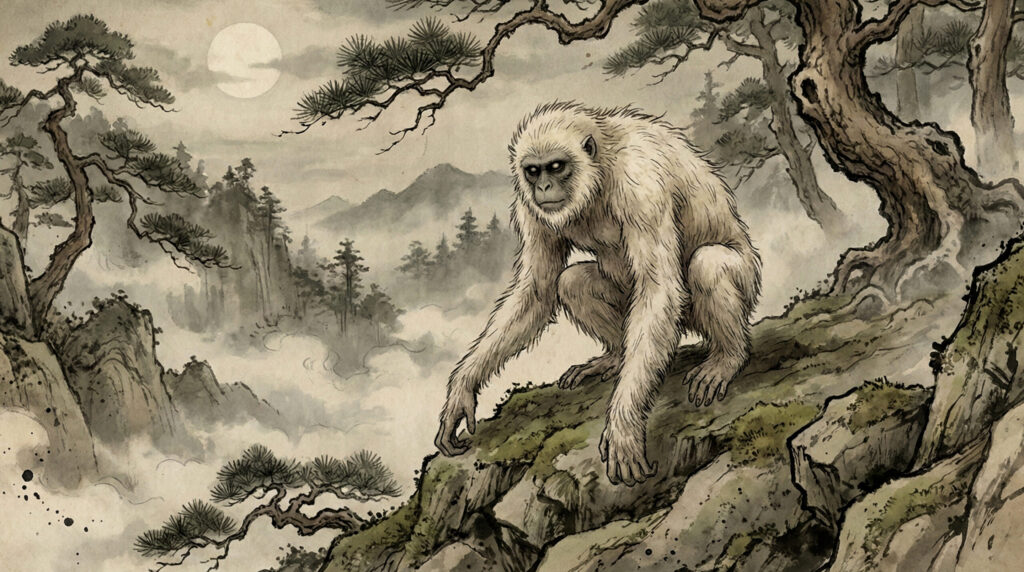
A sacred white ape guarding mountain territory.
It represents untamed divine authority.
Primary Sources
Mountain & Guardian Lore
- Regional mountain shrine records
- Yanagita Kunio — Studies of Mountain Beliefs
- Komatsu Kazuhiko — Yōkai Encyclopedia
Hakuen – The White Ape That Dwells Between Beast, Spirit, and Mountain in Japanese Folklore
Hakuen, the White Ape, is a rare and liminal figure in Japanese folklore—neither fully yōkai, nor divine beast, nor ordinary animal. It is a mountain-dwelling presence associated with whiteness, longevity, and spiritual boundary.
It does not hunt humans.
It does not speak.
Yet it is never mistaken for an animal.
Hakuen embodies the mountain observing humanity through another species.
Origins in Mountain Asceticism and Sacred Beasts
The image of the white ape is strongly connected to mountain belief systems and ascetic traditions. White animals in Japanese folklore often signal sacredness, rarity, or proximity to the divine. Hakuen emerges where animal life and spiritual practice intersect.
In some traditions, white apes are said to appear near sacred peaks, remote valleys, or places of rigorous training. Their presence marks a threshold rather than an event.
The mountain allows itself to be seen.
Neither Yōkai Nor Kami
Hakuen occupies an intermediate position:
- Not a yōkai born of fear or resentment
- Not a kami requiring worship
- Not a mere animal driven by instinct
It behaves according to the mountain’s rhythm, not human morality. When humans encounter Hakuen, the moment is remembered not as danger, but as interruption.
It is not hostile.
It is not welcoming.
Appearance and Symbolic Whiteness
Descriptions of Hakuen emphasize visual contrast:
A large ape with pure white fur
Eyes calm, alert, and humanly aware
Movements deliberate and restrained
A presence that commands silence
The whiteness is not decorative. It signifies separation from ordinary life—an animal that no longer belongs fully to nature or humanity.
White marks what should not be touched.
Behavior and Silent Authority
Hakuen does not interfere directly with humans. Its influence is subtle:
It watches from elevated ground
It withdraws when approached
It appears briefly, then vanishes
It leaves no trace
Those who encounter Hakuen often feel compelled to stop, turn back, or remain silent.
The message is never spoken.
Hakuen as a Boundary Being
Hakuen functions as a living boundary marker:
Between wilderness and sacred ground
Between animal instinct and spiritual awareness
Between movement and stillness
Its presence suggests that the land beyond belongs to something older and deeper.
Crossing without acknowledgment invites misfortune.
Symbolism and Themes
Sacred Otherness
Not all life is equal.
Observation Without Judgment
Seen, but not condemned.
Whiteness as Separation
Purity that excludes.
Mountain as Watcher
The land is aware.
Related Concepts
Mountain Guardian Spirits
Protective yet untamed mountain beings.
Animal Deity Motif
Animal-shaped divine manifestations.
Sacred Boundary Folklore
Spirits guarding human–nature borders.
Hakuen in Folklore Memory
Hakuen appears rarely in written folklore, surviving instead through scattered references and symbolic associations. This scarcity enhances its power—it feels credible precisely because it is uncommon.
One sighting is enough.
Modern Cultural Interpretations

This blade symbolizes wild divine authority and boundary enforcement.
It visualizes punishment delivered without warning.
Modern interpretations often frame Hakuen as a metaphor for untouched nature — ecosystems that observe humanity without engagement or judgment.
Psychologically, Hakuen represents encounters with the non-human gaze: the unsettling sensation of being watched by an intelligence that does not share human priorities, ethics, or emotional frameworks.
In some contemporary visual reinterpretations, Hakuen appears in the form of a yōtō — a blade that reflects wilderness rather than will. It does not seek conflict, yet remains present as a silent witness, embodying nature’s indifference rather than hostility.
Hakuen persists because wilderness still looks back.
Modern Reinterpretation – Hakuen as the Silent Witness of Wilderness
In this reinterpretation, Hakuen is not depicted as a beast or guardian, but as the embodiment of untouched nature — a sentient stillness observing the human world from beyond its edges.
The “beautiful girl” form reflects the paradox of purity and indifference. Her white hair and calm expression echo the mountain’s detachment — serene, vast, and unpossessed.
She does not threaten or console. Her presence is awareness itself, the quiet intelligence of the wild observing without intention.
She stands between human narrative and natural silence, embodying the gaze of wilderness that neither judges nor welcomes — only remembers.
In this visual reinterpretation, Hakuen becomes the spirit of non-intervention — beauty that looks back, untouched by the need to be understood.
Musical Correspondence
The accompanying track translates wilderness into tone and distance. Sparse instrumentation and elevated harmonics mirror the thin air of high peaks and the rhythm of breathing in solitude.
Long pauses act as awareness, while subtle drones evoke the mountain’s patience — a soundscape that listens more than it speaks.
By emphasizing observation over expression, the music captures Hakuen’s essence: a sacred witness that endures without interference, and a silence vast enough to hear the world as it is.

She embodies mountain law and sacred exclusion.
Her calm gaze reflects unseen territorial judgment.
Dreamy and stylish
Genre: Ritual Japanese HipHop / Darkwave Folklore Produced by: Phantom Tone | Suno AI | Kotetsu Co., Ltd. Tags: #JapaneseHipHop #AIgeneratedMusic #Yokai #Phant…