
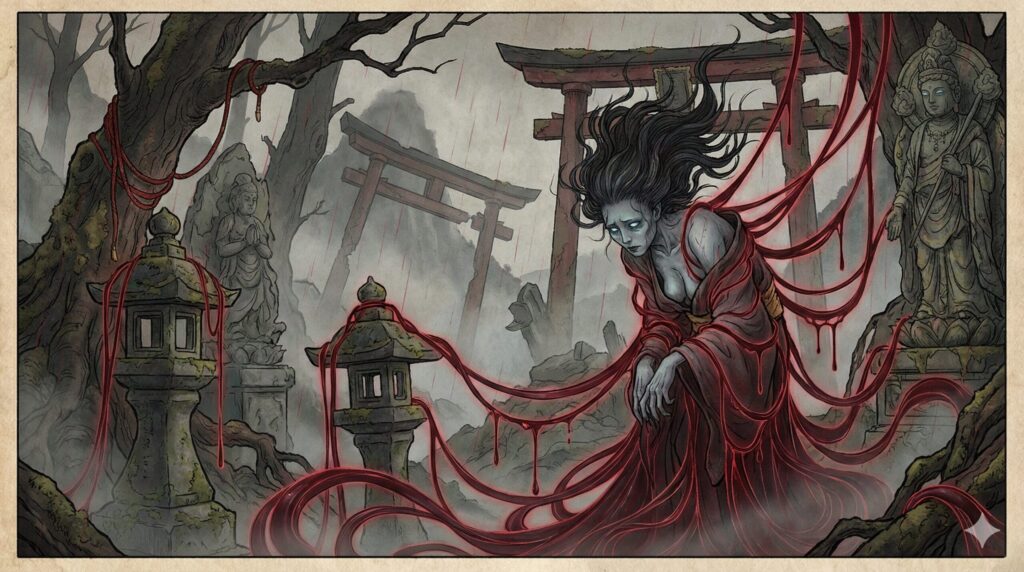
Kankandara – The Rattling Skeleton Spirit of Japanese Folklore
Kankandara is a stark and unsettling yōkai of Japanese folklore: a skeletal spirit whose presence is announced not by appearance, but by sound. The name itself evokes the eerie clatter of bones—kan-kan—echoing through mountain paths, graveyards, or abandoned places. Unlike yōkai that seduce or deceive, Kankandara confronts humans with the raw reminder of death’s inevitability.
Often described as a walking skeleton or a bone-like apparition, Kankandara does not always attack. In many accounts, it simply appears, rattles, and vanishes. Yet this minimal action carries profound weight. Its role is less that of a predator and more that of a manifestation: a sound made visible, a warning given form.
Origins and Early Depictions
References to skeletal spirits appear throughout Japanese folklore, but Kankandara stands out for its emphasis on sound and motion rather than narrative complexity. Early mentions are sparse and regional, suggesting that the figure emerged from oral traditions tied to mountain travel and burial sites.
The clattering noise associated with Kankandara is central to its identity. In pre-modern Japan, where night travel was dangerous and burial grounds were closely tied to spiritual anxiety, unexplained sounds carried supernatural significance. A rattling echo in the darkness could signal restless dead, improper rites, or the presence of a boundary between the living world and the realm of spirits.
Early depictions often avoid detailed illustration, reinforcing the idea that Kankandara is something sensed before it is seen.
From Restless Bones to Omens of Death
Over time, Kankandara came to be interpreted less as a single creature and more as a category of apparition: the animated remains of the dead, given temporary motion by unresolved attachment or disrupted order.
In some stories, encountering Kankandara foretells death or misfortune. In others, it appears near execution grounds, battlefields, or mountain passes where travelers have died. Its skeletal form strips away individuality—there is no face, no voice, only bone. This anonymity transforms Kankandara into a universal symbol rather than a personal ghost.
Appearance and Behavior
Descriptions vary, but several elements recur across traditions:
Skeletal Form
Kankandara is commonly described as a human skeleton, sometimes incomplete, sometimes towering unnaturally tall.
Rattling Sound
The clacking of bones is its defining trait. The sound may precede its appearance or be the only sign it was ever there.
Sudden Manifestation
It often appears without warning, crossing paths briefly before vanishing into darkness.
Passive Threat
Unlike aggressive yōkai, Kankandara rarely attacks. Its power lies in confrontation rather than violence.
Symbolism and Themes
Confrontation with Mortality
Kankandara embodies death stripped of metaphor. There is no disguise, no illusion—only the bare structure that remains when life is gone.
Sound as Presence
The emphasis on noise highlights the fear of what cannot be seen. The rattling announces existence without explanation.
Restless Dead and Improper Rites
Its appearance often implies disrupted burial practices, unresolved deaths, or spiritual imbalance.
Anonymity of Death
With no identity or story, Kankandara represents death as a universal condition rather than a personal tragedy.
Kankandara in Literature and Art
Kankandara is less prominent in classical art than more visually striking yōkai, yet it appears in yōkai catalogs and regional illustrations as:
- a skeletal figure mid-stride,
- a silhouette accompanied by scattered bones,
- a minimalist form emphasizing emptiness rather than horror.
Its visual simplicity enhances its symbolic force, allowing it to function as a moving memento mori.
Regional Legends and Local Beliefs
Local traditions describe Kankandara in various contexts:
- mountain roads where travelers hear bones clattering behind them,
- abandoned burial sites where skeletons are said to walk at night,
- battlefields where the dead never received proper rites,
- warnings to avoid certain paths after dusk.
These stories often serve practical purposes: discouraging night travel and reinforcing respect for the dead.
Modern Interpretations
In modern media, Kankandara appears as a skeletal yōkai or abstract death symbol. Contemporary interpretations often emphasize:
- its rhythmic, sound-based presence,
- its lack of narrative motive,
- its suitability for atmospheric horror rather than direct violence.
Its simplicity allows creators to use it as a visual or auditory motif representing mortality itself.
Conclusion – Death Given Motion and Sound
Kankandara endures as one of the most minimal yet powerful figures in Japanese folklore. It does not tempt, deceive, or pursue—it merely appears, rattles, and reminds. In doing so, it confronts humans with the reality they most often avoid: that all life ends in the same silent structure of bone.
Its presence transforms sound into warning, movement into omen, and the night into a space where mortality briefly walks beside the living.
Music Inspired by Kankandara
Music inspired by Kankandara naturally centers on rhythm and texture. Percussive elements can mirror the clatter of bones, while sparse arrangements evoke emptiness and exposure. Irregular timing and hollow resonance can create unease without relying on melody, reflecting the spirit’s lack of personality or intent.
Silence plays a crucial role—moments where sound drops away entirely before returning in sharp, skeletal patterns. Through restraint, repetition, and stark contrast, music can capture the essence of Kankandara: death not as spectacle, but as an unavoidable presence that announces itself briefly, then fades back into darkness.
Kankandara
Genre: Japanese Folklore HipHop / Darkwave Trap / AI-Generated Music Produced by: Phantom Tone | Suno AI | Kotetsu Co., Ltd. Tags: #JapaneseHipHop #AIgenerated…
 Phantom Tone – Japanese Folklore Hip-Hop Project