
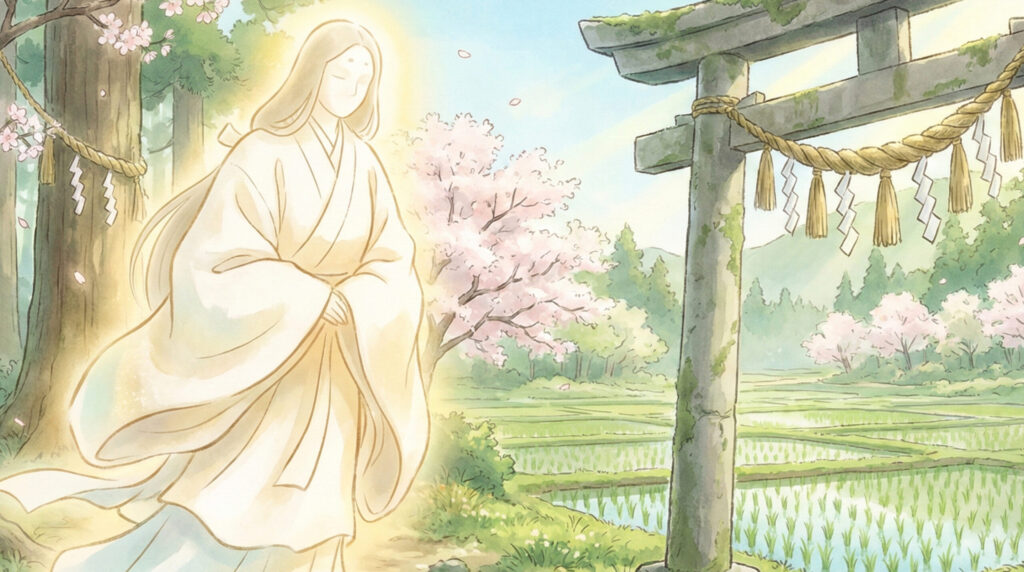
Nigimitama represents harmony, blessing, and protection.
It governs peace, healing, and stable fortune.
Primary Sources
Classical & Shinto Records
- Kojiki (古事記) — Mitama division traditions
- Nihon Shoki (日本書紀) — Spirit manifestation records
- Shrine theological writings on Mitama classification
- Komatsu Kazuhiko — Yōkai Encyclopedia
Nigimitama – The Harmonizing Aspect of Divinity in Japanese Folklore
Nigimitama(和御魂) refers to the calming, stabilizing, and beneficent aspect of a kami in Japanese belief. It is not a separate god, spirit, or entity, but a mode of divine expression—the state in which sacred power is moderated, relational, and capable of coexistence with human society.
Where aramitama represents divine force in excess, nigimitama represents divine force in balance. Together, they form a paired conceptual system that defines how kami interact with the world.
Dual Aspects of Kami Power
Japanese religious thought does not assume that divinity is inherently gentle or destructive. Instead, kami are understood to possess multiple operational states, among which aramitama and nigimitama are foundational.
- Aramitama(荒): rupture, calamity, overflow
- Nigimitama(和): harmony, protection, continuity
These are not moral opposites. They are functional conditions, activated by circumstance, recognition, and ritual engagement.
Nigimitama as Pacified Power
Nigimitama emerges when divine force is:
- Properly acknowledged
- Ritually engaged
- Integrated into social and spatial order
Shrines, festivals, offerings, and seasonal rites function not merely as devotion, but as mechanisms of modulation, guiding kami power into a form compatible with daily life.
Nigimitama is thus not passive benevolence—it is power under management.
Relationship to Human Society
Unlike aramitama, which manifests independently of human consent, nigimitama is deeply relational.
It supports:
- Agricultural fertility
- Community protection
- Political stability
- Continuity of place
Nigimitama enables kami to become guardians rather than threats, allowing sacred presence to settle rather than erupt.
Distinction from Goryō and Pacified Spirits
While nigimitama may appear similar to goryō (pacified spirits), their origins differ.
- Goryō: human-derived resentment transformed through ritual
- Nigimitama: divine force moderated through engagement
Nigimitama do not arise from grievance. They arise from successful containment of power.
Symbolism and Cultural Meaning
Harmony as Active State
Nigimitama are not the absence of violence; they are the active maintenance of balance.
Ritual as Infrastructure
Ritual does not symbolize peace—it produces it. Nigimitama exist because ritual succeeds.
Sacred Presence That Remains
Unlike aramitama, which appears as event or disaster, nigimitama persist. They dwell, protect, and repeat.
Related Concepts
Mitama (御魂)
The plural aspects of divine spirit.
Aramitama (荒御魂)
Violent, active manifestation of kami.
→Aramitama
Divine Polarity Motif
Dual-aspect god representation.
Later Developments and Interpretation
In later eras, nigimitama often became the default image of kami, while aramitama receded into the background. This shift reflects social preference rather than theological elimination.
However, the nigimitama state is never permanent. Without continued recognition, moderation collapses, and divine force may revert.
Relationship to the Four-Mitama System
In some traditions, nigimitama is discussed alongside:
- Aramitama(荒)
- Kushimitama(奇)
- Sakimitama(幸)
Within this system, nigimitama represents stability and settlement, anchoring more volatile or miraculous expressions.
Modern Cultural Interpretations

This blade symbolizes quiet blessing and invisible protection.
It visualizes fortune that stabilizes rather than conquers.
In modern interpretations, Nigimitama is understood as the harmonizing face of divinity — the force that stabilizes, nurtures, and restores balance after disruption. Contemporary readings often associate it with healing, social cohesion, and the quiet maintenance of order.
Psychologically, Nigimitama reflects the need for reassurance, belonging, and emotional equilibrium. It embodies the impulse to repair rather than confront, to soothe rather than divide.
In some modern visual reinterpretations, Nigimitama manifests as a yōtō — a blade that heals rather than harms. The sword appears tempered to restore symmetry, cutting only what disturbs harmony. Its presence suggests correction through balance, not domination.
Nigimitama persists because harmony still requires guardianship.
Modern Reinterpretation – Nigimitama as the Yokai of Sustained Harmony
In this reinterpretation, Nigimitama is not portrayed as a distant deity, but as a stabilizing presence that remains within human space.
The “beautiful girl” form does not command. She reassures.
Her gentle expression represents continuity, emotional safety, and the quiet maintenance of balance — spaces that recover, communities that settle, and systems that heal rather than divide.
She does not correct through force. She restores through presence.
In this visual form, Nigimitama becomes a contemporary yokai of sustained harmony — a spirit that maintains equilibrium rather than enforcing it.
Musical Correspondence
The accompanying track translates continuity into sound. Gentle cycles, flowing harmony, and restrained rhythm evoke balance that persists without urgency.
Soft resolution, repeating motifs, and steady tonal centers mirror the presence of something that remains rather than departs.
Together, image and sound form a unified reinterpretation layer — a modern folklore artifact of harmony that stays.

She embodies quiet blessing and unseen guardianship.
Her presence represents harmony that does not demand notice.
Where Gods Fall Silent
Genre: Japanese Folklore Hip-Hop / Darkwave Enka Trap Produced by: Phantom Tone | Suno AI | Kotetsu Co., Ltd. Tags: #JapaneseFolklore #AIgeneratedMusic #LoFiJa…