
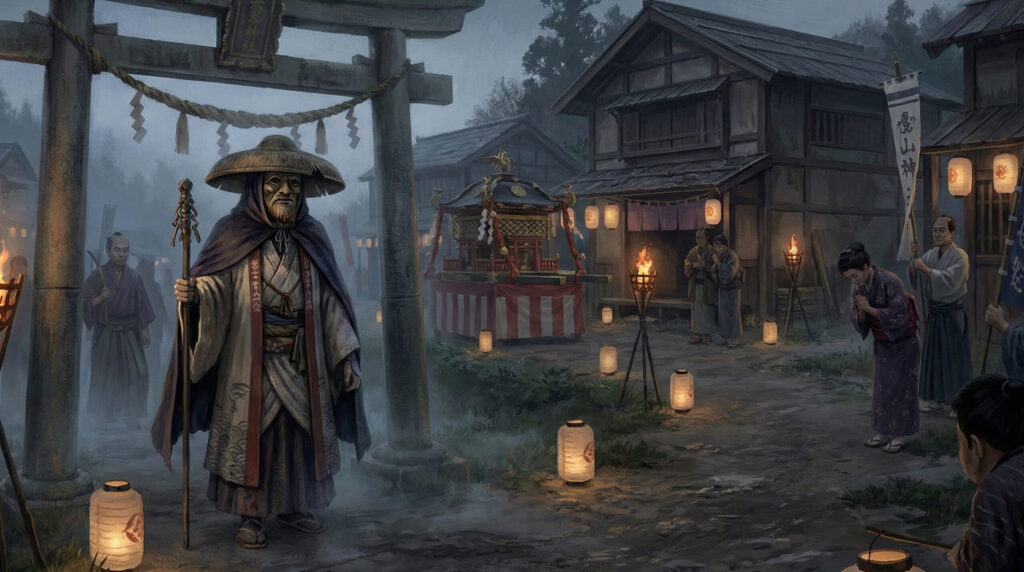
Marebito are visiting deities or spirits who arrive unannounced.
They represent blessing, testing, and boundary crossing.
Primary Sources
Classical & Shinto Folklore Records
- Yanagita Kunio — Tōno Monogatari
- Kojiki (古事記)
- Shrine ritual records
- Komatsu Kazuhiko — Yōkai Encyclopedia
Marebito – Visiting Deities and the Logic of Arrival in Japanese Folklore
Marebito(客人神) refers to a foundational concept in Japanese folklore describing sacred beings who arrive from outside the community, bringing blessings, renewal, or corrective force. Unlike resident kami bound to specific land or shrines, marebito are defined by movement and arrival. Their power lies not in permanence, but in temporality.
Marebito are not a single deity type, nor a specific yokai. They are a structural role within folk belief—a way of understanding how the outside world periodically enters the human sphere with transformative effect.
The Core Logic of Marebito
At the heart of the marebito concept is a simple but profound assumption:
the outside is powerful.
Villages are closed systems—stable, repetitive, and socially regulated. Marebito arrive from beyond this system, often from:
- Mountains
- The sea
- The otherworld
- The unknown periphery
Because they come from outside established order, marebito carry potential—for blessing, judgment, or disruption.
Arrival as Sacred Event
Marebito are defined less by who they are than by when and how they arrive.
Key features include:
- Seasonal or calendrical appearance
- Ritualized reception
- Departure after function is fulfilled
Their arrival transforms ordinary time into ritual time, marking moments of renewal, transition, or moral correction.
Namahage as a Marebito Expression
Namahage exemplify the marebito structure with particular clarity.
- They arrive from the mountains
- They enter households temporarily
- They admonish, threaten, and instruct
- They depart without remaining
Their frightening appearance does not contradict their sacred role. In marebito logic, fear is a legitimate vehicle of instruction.
Namahage are not demons invading the village. They are guests performing a sanctioned function.
Marebito Versus Resident Kami
This distinction is essential.
- Resident kami
- Bound to land or shrine
- Continuous presence
- Protective through stability
- Marebito
- Temporarily present
- Defined by arrival and departure
- Transformative through interruption
Marebito do not guard order—they reset it.
Relationship to Oni and Masked Figures
Many marebito appear in fearsome or masked forms. This does not indicate demonic nature, but anonymity.
By obscuring identity, marebito:
- Avoid personal responsibility
- Represent collective authority
- Channel forces larger than the individual
This explains why marebito figures often resemble oni without being classified as such.
Symbolism and Cultural Meaning
The Outside as Source of Renewal
Marebito express the belief that stagnation is dangerous. Renewal must come from beyond the familiar.
Fear as Education
Threats, admonitions, and tests are tools of moral maintenance, not cruelty.
Hospitality as Ritual Obligation
Even terrifying guests must be received correctly. Improper reception risks misfortune.
Related Concepts
Divine Visitor Lore
Beliefs surrounding visiting gods and outsiders.
Boundary Crossing Deities
Spirits that cross village and otherworld boundaries.
Hospitality & Testing Motifs
Myths testing purity and social order.
Marebito as Conceptual Framework
Marebito function as a theoretical backbone for understanding many disparate traditions:
- Visiting gods
- Seasonal demons
- Masked admonitory figures
Rather than treating these as unrelated folklore, marebito provide a unifying explanatory model.
Modern Cultural Interpretations

This blade symbolizes trial, hospitality testing, and sacred intrusion.
It visualizes blessing and calamity arriving without warning.
In modern society, marebito are often softened into festival mascots or friendly symbolic figures. While culturally valuable, such portrayals risk obscuring their original function as agents of disruption, judgment, and correction.
Contemporary reinterpretations that restore tension — arrival, fear, and departure — align more closely with traditional folklore logic, where the visitor does not comfort but tests the moral and spiritual condition of the community.
In some modern visual reinterpretations, marebito manifest as a yōtō — a blade that appears only briefly. The sword is not meant to remain; it arrives, passes judgment through presence alone, and vanishes. Its danger lies in impermanence rather than violence.
Marebito persist because what arrives from outside still has the power to change everything.
Modern Reinterpretation – Marebito as the Yokai of External Correction
In this reinterpretation, Marebito is not treated as a festive guest or benevolent spirit, but as a transient corrective phenomenon.
The “beautiful girl” form represents arrival itself — the unknown that steps into closed systems, observes, alters, and then disappears.
Her presence is brief, calm, and unreadable. She does not explain. She does not remain.
Communities are not changed by what stays, but by what visits and leaves.
In this visual form, Marebito becomes a contemporary yokai of external correction — a spirit that enters from outside the system, modifies it through presence alone, and then withdraws.
Musical Correspondence
The accompanying track translates visitation into sound. Strong motifs emerge suddenly, linger briefly, and dissolve without resolution.
Melodies behave like footsteps — heard, recognized, and then gone.
Together, image and sound form a unified reinterpretation layer — a modern folklore artifact recording the power of what arrives, changes, and disappears.

This contemporary form represents sacred visitation and social testing.
She embodies blessing, trial, and boundary crossing.
The Visitor
Genre: Japanese Folklore Hip-Hop, Ritual Lo-Fi Poetry Produced by: Phantom Tone | Suno AI | Kotetsu Co., Ltd. Tags: #AIgeneratedMusic #JapaneseHipHop #Folklore…

Dreamy and stylish
Genre: Ritual Japanese HipHop / Darkwave Folklore Produced by: Phantom Tone | Suno AI | Kotetsu Co., Ltd. Tags: #JapaneseHipHop #AIgeneratedMusic #Yokai #Phant…