
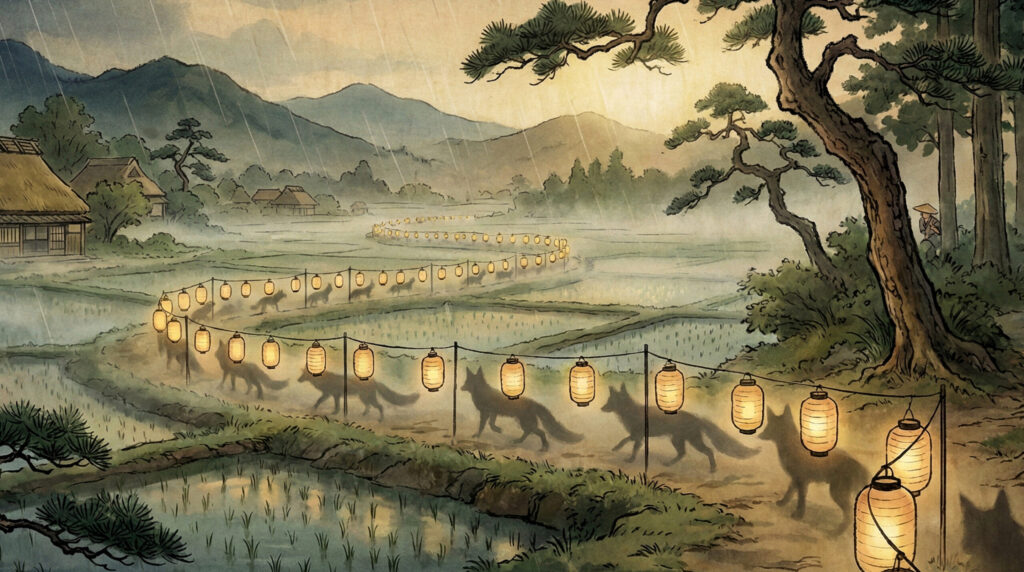
Kitsune no Yomeiri refers to a fox wedding procession seen during sunshowers.
It represents illusion, boundary crossing, and spirit rituals.
Primary Sources
Classical & Regional Folklore Records
- Yanagita Kunio — Tōno Monogatari
- Regional fox-marriage oral traditions
- Komatsu Kazuhiko — Yōkai Encyclopedia
Kitsune no Yomeiri – Phantom Wedding Processions of Japanese Folklore
Kitsune no Yomeiri, or “the Fox’s Wedding,” is one of the most poetic and enigmatic motifs in Japanese folklore. Rather than a single creature, it describes a supernatural event: a mysterious wedding procession of fox spirits, often glimpsed at dusk, in rain under a clear sky, or through lines of floating lantern lights.
This phenomenon blurs the boundary between illusion and reality. Witnesses are never meant to approach too closely. Those who do may become lost, enchanted, or quietly misled. Kitsune no Yomeiri is not an act of violence or punishment, but a revelation of a parallel world momentarily overlapping with the human one.
At its core, the legend expresses the fragility of perception and the beauty of things that cannot be fully grasped.
Origins and Early Accounts
References to fox weddings appear across Japan, with regional variations dating back centuries. In many areas, the term originally referred to a strange natural occurrence: sunshower rain—rain falling while the sun is shining. Over time, this meteorological oddity became associated with fox magic and illusion.
Early folklore describes people witnessing long lines of lantern lights moving silently through fields, forests, or mountain paths at night. Believing them to be human wedding processions, villagers sometimes followed—only for the lights to vanish, leaving them disoriented or far from home.
These stories reinforced the belief that foxes (kitsune) were masters of illusion, capable of mimicking human customs while remaining fundamentally otherworldly.
Foxes and the Liminal World
In Japanese folklore, foxes occupy a deeply liminal position. They are shape-shifters, messengers of Inari, tricksters, and guardians—sometimes benevolent, sometimes deceptive. A wedding, itself a rite of transition, becomes a perfect narrative vessel for fox symbolism.
Kitsune no Yomeiri is not merely about marriage, but about crossing thresholds: childhood to adulthood, solitude to union, human to spirit. The fox wedding exists at twilight—between day and night—and often during unusual weather, reinforcing its placement between worlds.
The event is fleeting, visible only to those who happen to be in the right place at the wrong—or right—moment.
Appearance of the Procession
Descriptions of the fox wedding procession are strikingly consistent:
A long line of softly glowing lanterns
Figures dressed in formal wedding attire
Silent movement without spoken words
A path through forests, rice fields, or hills
Disappearance upon close approach
The bride and groom themselves are rarely described in detail. Attention is drawn instead to the atmosphere: light, mist, rain, and quiet motion. This vagueness preserves the sense that the event is not meant to be fully seen or understood.
Human Encounters and Consequences
Encounters with kitsune no yomeiri are typically non-lethal but disorienting. Those who interfere or attempt to follow may experience:
Becoming lost for hours or days
Sudden exhaustion or confusion
Embarrassment upon realizing the illusion
A lingering sense of having crossed into something forbidden
Importantly, these consequences are subtle. There is no dramatic curse or transformation. The punishment, if any, is gentle but unsettling—a reminder of human limitation.
Symbolism and Themes
Illusion and Perception
The fox wedding questions what is real and what is merely seen.
Liminal Time and Space
It occurs at thresholds: dusk, night, unusual weather, borders between places.
Hidden Parallel Worlds
The procession suggests a fully formed society existing just beyond human awareness.
Respect for the Unseen
Those who observe from afar remain unharmed; intrusion brings confusion.
Related Concepts
Fox Illusion Lore
Kitsune illusions and trickster rituals.
Weather Anomaly Myths
Sunshower and contradictory weather phenomena.
Liminal Wedding Motifs
Rituals crossing human and spirit worlds.
Regional Variations
Different regions interpret kitsune no yomeiri in unique ways. In some areas, it is purely a supernatural explanation for sunshowers. In others, it is a literal spirit procession with social structure and intent.
Some villages treated sightings as auspicious, while others viewed them as warnings. The same phenomenon could inspire wonder or unease depending on local tradition.
This flexibility has allowed the legend to persist across centuries, adapting to changing beliefs without losing its core mystery.
Kitsune no Yomeiri in Art and Culture
Fox weddings have long inspired painters, poets, and storytellers. Edo-period illustrations often depict winding lantern lines stretching into darkness, emphasizing depth and distance rather than character detail.
In modern culture, kitsune no yomeiri frequently appears in films, anime, and games as a visual metaphor for illusion, nostalgia, or the thin veil between worlds. The imagery of glowing lights in rain remains one of the most evocative symbols in Japanese supernatural aesthetics.
Modern Cultural Interpretations

This blade symbolizes illusion, liminal ritual, and deceptive procession.
It visualizes celebration that conceals otherworldly presence.
Contemporary interpretations often frame the fox wedding as a symbol of parallel realities, fading traditions, and emotional memory. Rather than focusing on deception, modern retellings emphasize beauty, melancholy, and impermanence.
In these readings, the foxes appear less as tricksters and more as custodians of a world humans can no longer fully access — a realm that persists quietly alongside the visible one.
In some modern visual reinterpretations, the fox wedding is expressed as a yōtō — a blade that glimmers like lantern light at dusk. The sword does not call for battle; it marks passage between worlds, its edge tracing the line between presence and disappearance.
The fox wedding endures because some worlds are felt more than entered.
Modern Reinterpretation – Kitsune no Yomeiri as the Vision of a Parallel World
In this reinterpretation, Kitsune no Yomeiri is not treated as a trick or deception, but as a visible fragment of a world that exists beside ours — complete, inhabited, and emotionally real, yet unreachable.
The “beautiful girl” form represents a resident of that parallel continuity. Not a visitor. Not a ghost. But someone who belongs to a place humans cannot enter.
Her distant gaze mirrors the feeling of lantern light seen through rain — present, moving, and meaningful, yet never approaching.
She does not invite. She passes — because parallel worlds do not open gates.
In this visual form, Kitsune no Yomeiri becomes a modern yokai of parallel reality — a living proof that another world moves beside ours without overlapping it.
Musical Correspondence
The accompanying track translates parallel motion into sound. Soft pulses echo procession without destination.
Harmonic drift mirrors worlds that never align. Melody becomes presence without access.
Together, image and sound form a unified reinterpretation layer — a modern folklore artifact recording a world that can be seen, but never entered.

This contemporary form represents liminal ritual and fox illusion.
She embodies boundary crossing and hidden procession.
konkon sama
Genre: Ritual Lo-Fi Japanese HipHop / Shinto Folklore Fusion Produced by: Phantom Tone | Suno AI | Kotetsu Co., Ltd. Tags: #JapaneseHipHop #AIgeneratedMusic #W…