What Is Hyakki Yagyō?
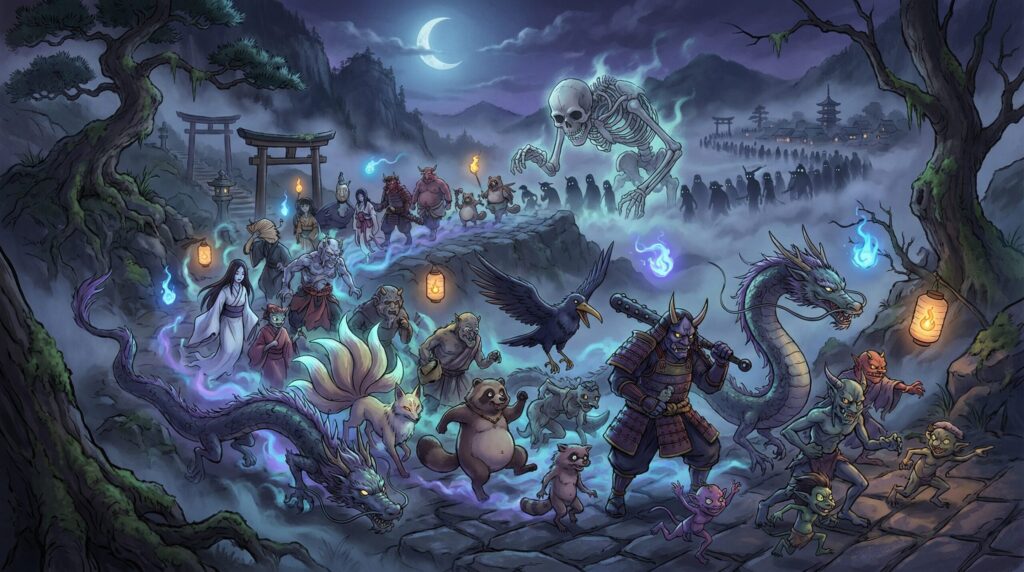
Hyakki Yagyō (百鬼夜行), often translated as "Night Parade of One Hundred Demons", is one of the most iconic themes in Japanese folklore. It describes a mysterious night phenomenon in which countless yōkai, ghosts, spirits, and transformed objects march in a long procession through the darkness.
The concept appears as early as the Heian period and developed through medieval literature and Edo-period art, especially in illustrated scrolls. In many accounts, encountering the parade unprotected could lead to illness, spiritual harm, or even death.
At its core, Hyakki Yagyō represents a moment when the boundary between the human world and the spirit world dissolves, allowing the uncanny to spill into ordinary streets.
Symbolism of the Night Parade
Liminality of Night
Nighttime in Japanese folklore is a threshold — a time when rules weaken and spirits become active. The parade symbolizes this fragile boundary, where everyday order gives way to the unpredictable movements of the supernatural.
Social Commentary
Edo-period monsters often served as satire. Many yōkai represent human flaws, professions, beliefs, or anxieties of the era. Through the grotesque and the exaggerated, Hyakki Yagyō reflects how people saw power, hypocrisy, and change in their own society.
Calamity and Collective Fear
Some traditions claim the parade appears during epidemics, fires, or periods of unrest. In this sense, the procession becomes a metaphor for widespread unease — a moving image of disaster, uncertainty, and the things that cannot be controlled.
Yōkai Commonly Associated With Hyakki Yagyō
The roster of beings in Hyakki Yagyō changes in each scroll or tale, but several figures frequently appear and have become strongly linked to the idea of the night parade.
Tengu
Tengu are mountain-dwelling spirits known for their long noses, red faces, and fearsome presence. They are often portrayed as martial, proud, and deeply tied to remote, sacred landscapes.
Nue
Nue is a chimera-like creature with the face of a monkey, the body of a raccoon dog or tiger, and a snake for a tail. It is considered an omen of misfortune, illness, and political instability.
Bakeneko / Nekomata
Bakeneko and Nekomata are cats that gain supernatural powers after a long life. They may transform into human form, manipulate fire, or control the dead. Their presence in the parade hints at the uncanny potential hidden in familiar everyday creatures.
Kappa
Kappa are aquatic spirits with dish-shaped heads that hold water, the source of their power. Playful but dangerous, they embody both the attraction and the fear of rivers, ponds, and the unseen currents beneath the surface.
Oni
Oni are demons that embody cruelty, punishment, and raw destructive force. When they appear within Hyakki Yagyō, they often define the darker edge of the procession, suggesting judgment or chaos moving through the night.
Tsukumogami
Tsukumogami are household tools and objects that come to life after a hundred years. Old umbrellas, sandals, lanterns, and instruments gain faces and limbs and join the parade. They add humor and everyday familiarity to the otherwise eerie procession.
Taken together, these beings make Hyakki Yagyō a moving anthology of Japanese supernatural imagination.
The Acoustic Dimension — How the Parade “Sounds”
Historical descriptions of the Night Parade often emphasize sound as much as appearance. Accounts speak of:
- Footsteps spreading across empty streets at midnight
- Rustling fabrics and scraping, clattering objects
- Distant bells or ritual instruments echoing in the dark
- Indistinct whispers and laughter carried by the wind
- A low, collective murmur rising and fading like a tide
This acoustic dimension makes Hyakki Yagyō unique among many folklore motifs. It is not only a visual image but a soundscape of the unseen, suggesting a nocturnal symphony of spirits, footsteps, and shifting shadows.
Hyakki Yagyō in Edo-Period Art
Edo-period artists played a crucial role in shaping how people imagine the Night Parade today. Important works include:
- Gazu Hyakki Yagyō by Toriyama Sekien
- Various Hyakki Yagyō Emaki (Night Parade scrolls)
- Konjaku Hyakki Shūi and related collections
- Scrolls featuring tsukumogami processions
In these artworks, monsters are not only frightening. They are also characters with individuality, quirks, and implied backstories. Some are grotesque, others comical, many strangely charming. This mixture of fear, humor, and social observation remains a major influence on modern Japanese visual culture, from illustration to animation and game design.
Modern Interpretations of Hyakki Yagyō
In contemporary culture, Hyakki Yagyō is often reimagined in symbolic or metaphorical terms rather than as a literal parade of monsters. It can represent:
- A procession of unresolved emotions moving through the mind
- Urban chaos gathering after dark in modern cities
- The subconscious rising and taking visible form
- Collective anxiety and social tension embodied as marching shadows
The theme appears in video games, manga, anime, films, literary fiction, and fine art. Artists and writers use the Night Parade as a flexible structure through which to explore identity, fear, memory, and transformation.
Musical and Artistic Reimaginings
Many modern creators draw on the atmosphere of Hyakki Yagyō rather than its exact cast of yōkai. Common elements include:
- Mist-filled streets illuminated by lanterns
- Drifting silhouettes of spirits and monsters
- Processional rhythms that evoke footsteps or ritual dances
- Hybrid aesthetics combining traditional motifs with contemporary styles
Through these reinterpretations, Hyakki Yagyō becomes a bridge between historical folklore and present-day music, visual art, and narrative worlds.
Why Hyakki Yagyō Captivates Global Audiences
The Night Parade continues to fascinate people around the world because it combines:
- Multiplicity – a vast, varied cast of supernatural beings
- Mystery – a phenomenon that appears only under special conditions
- Aesthetic richness – a distinct visual and atmospheric identity
- Emotional universality – fear of the dark, curiosity about the unknown, and the allure of crossing boundaries
As global interest in Japanese folklore, art, and mythology grows, Hyakki Yagyō remains one of the most recognizable and inspiring motifs, inviting endless reinterpretation.
Conclusion — The Enduring Influence of the Night Parade
Hyakki Yagyō is more than a simple monster parade. It is a cultural lens through which Japan has expressed anxiety and humor, memory and imagination, the beauty of ambiguity, and the power of collective storytelling.
From classical scrolls to contemporary media, the Night Parade continues to move across centuries, reshaped by new artists and new contexts. It remains a timeless reminder that when darkness falls, countless unseen worlds may begin to move.