
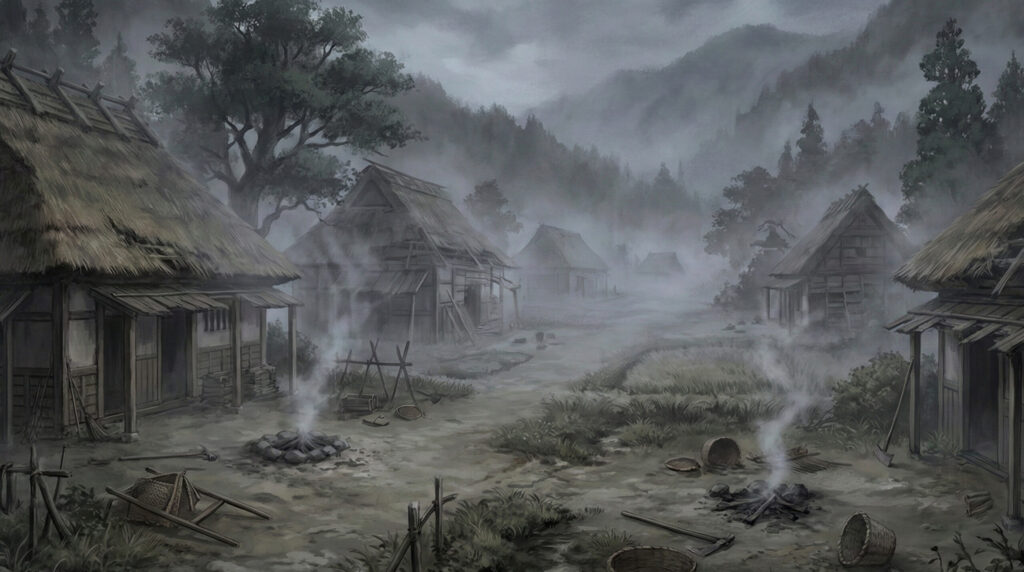
Disappearing villages represent settlements that fade from maps, memory, and social record.
They symbolize collective disappearance and forgotten communities.
Primary Sources
Classical & Regional Folklore Records
- Yanagita Kunio — Tōno Monogatari
- Regional hidden-village oral traditions
- Komatsu Kazuhiko — Yōkai Encyclopedia
Disappearing Villages – Vanished Settlements and the Expansion of Tokakushi in Japanese Folklore
Disappearing Villages(消える村の怪異) refers to a class of folkloric phenomena in which entire settlements vanish from memory, record, or physical presence, often leaving behind only fragmentary traces—ruins without names, place-names without locations, or oral accounts without confirmation. Unlike individual cases of Tokakushi(戸隠し), which involve the disappearance of a person, this expanded framework addresses collective disappearance.
This category is best understood as an event-based and structural anomaly, where geography, memory, and social continuity collapse simultaneously.
From Individual Tokakushi to Collective Erasure
Traditional tokakushi narratives describe people being taken by gods, spirits, or the mountain—removed temporarily or permanently from the human world. Disappearing villages extend this logic from the individual to the communal.
The shift is crucial:
- Tokakushi: a person disappears from society
- Disappearing village: society itself disappears
What vanishes is not only life, but recognition.
The Role of Place-Name Loss
One defining feature of disappearing village narratives is the loss of place-names. In Japanese folk logic, naming stabilizes reality. When a village’s name is forgotten, altered, or erased, the place loses ontological certainty.
This erasure may manifest as:
- Maps that no longer match oral memory
- Villages known only through family stories
- Sacred sites whose original function is unknown
The absence of a name functions as evidence of anomaly.
Mechanisms of Disappearance
Disappearing villages are rarely explained through a single cause. Instead, folklore suggests overlapping mechanisms:
- Divine withdrawal: local kami abandon the settlement
- Boundary violation: taboos broken, inviting removal
- Collective tokakushi: the village crosses into another realm
- Memory collapse: survivors integrate elsewhere, dissolving identity
The lack of a definitive explanation is essential. Closure would negate the anomaly.
Relationship to Mountains and Liminal Geography
Many accounts situate disappearing villages near:
- Mountain passes
- Deep forests
- Remote valleys
- Old roads no longer in use
These are liminal zones where spatial orientation is unstable. Villages located here are imagined as precarious—present only as long as conditions are maintained.
The mountain does not destroy the village.
It reclaims it.
Distinction from Ruins and Abandonment
Disappearing villages must be distinguished from ordinary abandonment.
- Abandoned village: physical remains, clear history
- Disappearing village: incomplete remains, broken narrative
In folklore, the latter suggests intentional removal rather than decay. The village is not ruined—it is taken.
Related Concepts
Tokakushi (十隠し)
Legends of people and places vanishing without trace.
Hidden Village Myths
Settlements believed to exist outside ordinary space.
Collective Memory Erasure
Fear surrounding forgotten places and lost communities.
Social and Psychological Dimensions
These narratives often encode collective anxieties:
- Fear of depopulation and migration
- Loss of ancestral continuity
- Anxiety over communities being forgotten
By framing disappearance as supernatural, folklore transforms socio-historical loss into cosmic event.
Disappearing Villages as Structural Anomaly
Like marebito or shide no tabi, disappearing villages are not beings, but conditions. They function as:
- Warnings about neglecting ritual and memory
- Explanations for gaps in history
- Narratives that preserve loss without resolving it
They represent absence that refuses explanation.
Modern Cultural Interpretations

This blade symbolizes erasure, lost place-names, and collective disappearance.
It visualizes quiet removal rather than violent destruction.
In modern Japan, narratives of disappearing villages resonate strongly with:
- ghost towns and depopulated rural regions,
- lost communities submerged by dams,
- villages erased through disaster and forced relocation.
While contemporary discourse often frames these phenomena in economic, demographic, or environmental terms, folkloric logic preserves a different truth: disappearance itself is traumatic enough to demand mythic explanation.
In some modern visual reinterpretations, disappearing villages manifest as a yōtō — a blade that erases rather than wounds. The sword leaves no ruin, only absence, cutting memory out of place itself. Its violence is not destruction, but vanishing.
They persist because loss that leaves no trace still demands meaning.
Modern Reinterpretation – Disappearing Villages as a Contemporary Folk Anomaly
In this reinterpretation, disappearing villages are not treated as abandoned settlements, but as spatial anomalies — places that have been quietly removed from continuity.
The “beautiful girl” form represents what remains after a community has vanished: memory given shape, presence without population, and emotion without geography.
Her still posture and distant gaze mirror landscapes that no longer respond — fields that are no longer farmed, houses that no longer answer to names.
She does not wander. She waits — because waiting is all that remains when return is no longer possible.
In this visual form, disappearing villages become modern yokai of erased place — the spirit of communities taken whole rather than destroyed.
Musical Correspondence
The accompanying track translates erasure into sound. Slow, fading motifs evoke routines that no longer serve living bodies, while widening silence suggests roads that no longer lead anywhere.
Repetition without development mirrors memory that has nowhere to return. Melody becomes geography that has lost its population.
Together, image and sound form a unified reinterpretation layer — a modern folklore artifact preserving places that no longer exist in space, but still remain in feeling.
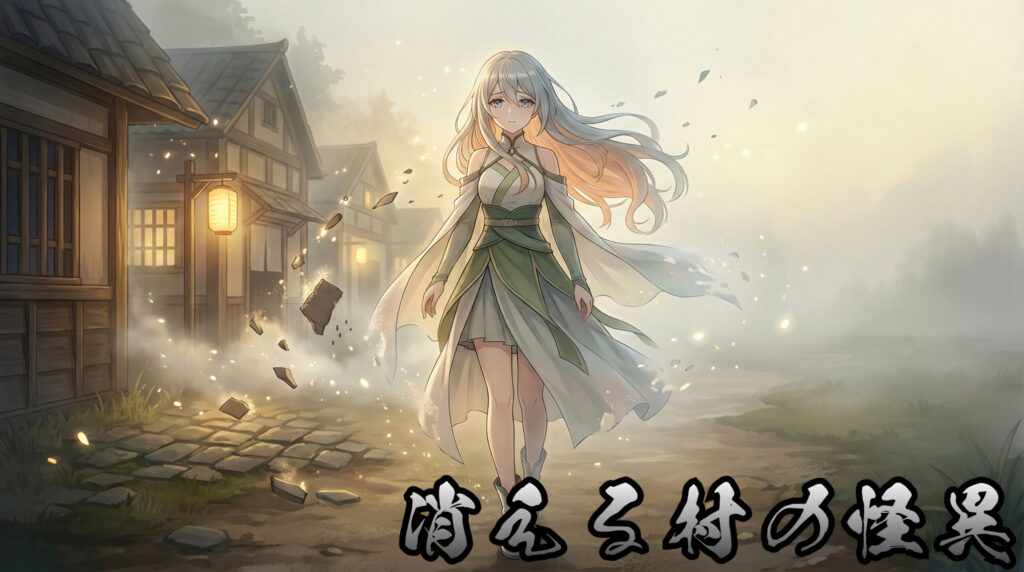
This contemporary form represents vanished communities and forgotten identities.
She embodies erasure, absence, and lost place-names.
Dreamy and stylish
Genre: Ritual Japanese HipHop / Darkwave Folklore Produced by: Phantom Tone | Suno AI | Kotetsu Co., Ltd. Tags: #JapaneseHipHop #AIgeneratedMusic #Yokai #Phant…