
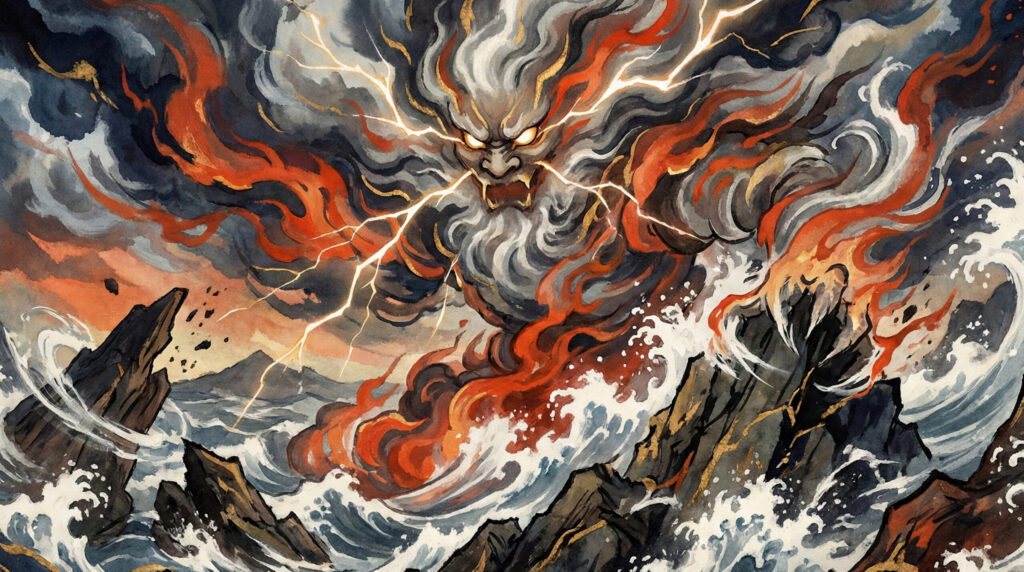
Aramitama is the violent and destructive aspect of a deity’s soul.
It represents divine wrath, calamity, and untamed sacred force.
Primary Sources
Classical Shinto Texts & Shrine Records
- Kojiki (古事記)
- Nihon Shoki (日本書紀)
- Shrine ritual records
- Komatsu Kazuhiko — Yōkai Encyclopedia
Aramitama – The Violent Aspect of Divinity in Japanese Folklore
Aramitama(荒御魂) refers to the volatile, destructive, and uncontrolled aspect of a kami in Japanese belief. Rather than an independent deity or monster, aramitama is a mode of divine operation—the state in which sacred power exceeds containment, regulation, or ritual balance.
Where kami are often approached as protectors or benefactors, aramitama reveals that divinity itself can become dangerous when unmediated. This concept foregrounds a central principle of Japanese religiosity: power is not inherently benevolent; it must be managed.
Duality Within the Kami
Japanese tradition frequently describes kami as possessing multiple aspects. Among these, the contrast between aramitama (荒) and nigimitama (和) is foundational.
- Nigimitama represents harmony, fertility, and stabilization
- Aramitama represents rupture, calamity, and force
These are not separate beings. They are expressions of the same divine source, shifting according to circumstance, recognition, and ritual engagement.
Aramitama as Uncontained Power
Aramitama emerges when divine force is:
- Disrespected or ignored
- Newly arrived and unappeased
- Disrupted by social or political imbalance
In such states, kami act without mediation. Natural disasters, sudden violence, and social collapse may be interpreted as manifestations of aramitama—not as punishment, but as overflow.
Relationship to Nature and Disaster
Aramitama is closely linked to overwhelming natural events:
- Earthquakes
- Storms and floods
- Volcanic activity
These are not random phenomena within folk logic. They are expressions of divine intensity exceeding the human capacity to absorb it. Ritual does not erase this power; it channels it.
Distinction from Oni and Yokai
Despite its violence, aramitama must be distinguished from demonic or monstrous categories.
- Oni embody externalized threat or moral inversion
- Yokai disrupt order through anomaly or mischief
- Aramitama disrupts order because it is order at maximum force
Aramitama is not anti-cosmic. It is cosmic without restraint.
Political and Ritual Implications
Historically, aramitama belief intersected strongly with governance. When disasters followed political turmoil, rulers sought to:
- Identify offended kami
- Perform pacifying rites
- Reframe aramitama into nigimitama
This process parallels the transformation of onryō into goryō, though aramitama originate from divinity rather than human grievance.
Symbolism and Cultural Meaning
Power Without Consent
Aramitama embody the fear that power does not require permission to act.
Necessity of Ritual
Ritual is not symbolic politeness—it is infrastructure for survival, regulating forces that cannot be eliminated.
Sacredness Without Comfort
Aramitama remind us that the sacred is not safe. Reverence exists because danger exists.
Related Concepts
Mitama (御魂) Theory
Divine soul aspects in Shinto belief.
Divine Wrath & Calamity Spirits
Spirits associated with disaster and divine anger.
Purification & Pacification Rites
Rituals intended to calm violent divine forces.
Aramitama in Later Interpretation
In later periods, aramitama were often visually softened or narratively constrained, emphasizing benevolent aspects of kami. However, traces of aramitama persist wherever sudden catastrophe is framed as divine presence rather than absence.
Modern reinterpretations that reduce kami to moral guardians obscure this older understanding of divinity as fundamentally ambivalent.
Modern Cultural Interpretations
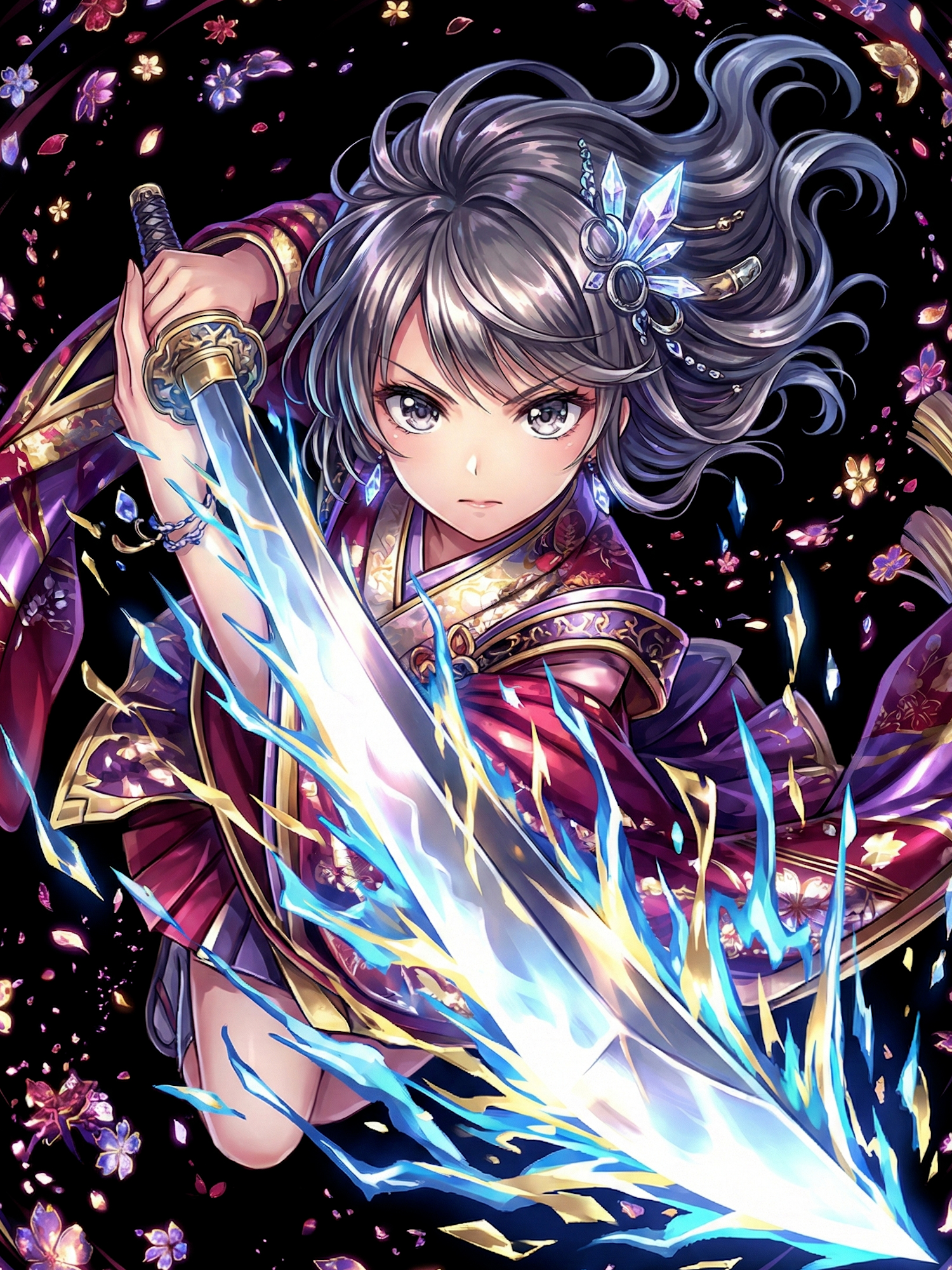
This blade symbolizes divine violence, calamity, and untamed sacred force.
It visualizes destructive power requiring ritual pacification.
In modern interpretations, Aramitama is often understood as the disruptive face of divinity — the force of upheaval, crisis, and violent correction that precedes transformation. Contemporary readings frame it not as “evil,” but as necessary instability that shatters stagnation.
Psychologically, Aramitama reflects moments when suppressed pressure erupts into action: anger that finally moves systems, disasters that reset priorities, and crises that expose hidden weaknesses. It embodies the part of order that must first be destroyed.
In some modern visual reinterpretations, Aramitama manifests as a yōtō — a blade that does not negotiate. The sword carries divine volatility, cutting through stagnation rather than enemies. To draw it is to accept irreversible change rather than victory.
Aramitama persists because transformation still begins with rupture.
Modern Reinterpretation – Aramitama as a Contemporary Yokai
In this reinterpretation, Aramitama is not treated as a violent deity, but as the exposed core of divinity — power before it is filtered into morality, law, or tradition.
Rather than punishing, it corrects. Rather than judging, it breaks. Its function is not destruction for its own sake, but forced realignment — the moment when stagnation collapses because it can no longer sustain itself.
The “beautiful girl” form represents the paradox of divine disruption: transformation that arrives softly in appearance, yet leaves irreversible change in its wake.
Her calm gaze conceals inevitability. She does not threaten. She ends what cannot continue.
In this visual reinterpretation, Aramitama becomes the personification of sacred rupture — a yokai that does not negotiate with the present, but clears space for the future.
Musical Correspondence
The accompanying track translates divine rupture into sound. Heavy pulses, overwhelming density, and relentless forward motion evoke power that cannot be reasoned with.
Sudden collapses into silence mirror the aftermath of sacred excess — not peace, but enforced stillness.
Together, image and sound form a unified reinterpretation layer — a contemporary myth of transformation rendered through audiovisual force.
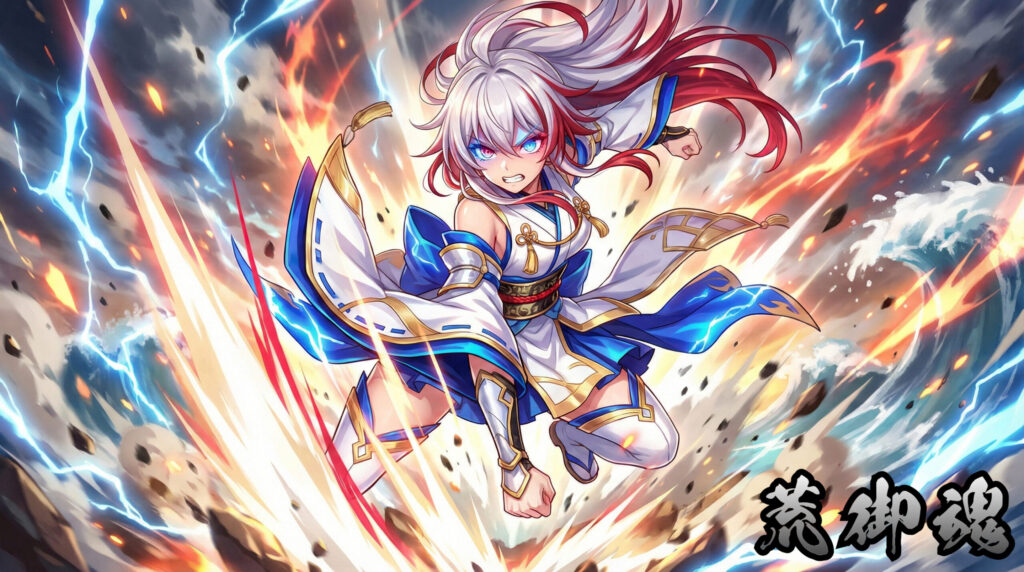
This contemporary form represents sacred rage and uncontrolled divine energy.
She embodies calamity, purification, and divine wrath.
Where Gods Fall Silent
Genre: Japanese Folklore Hip-Hop / Darkwave Enka Trap Produced by: Phantom Tone | Suno AI | Kotetsu Co., Ltd. Tags: #JapaneseFolklore #AIgeneratedMusic #LoFiJa…