
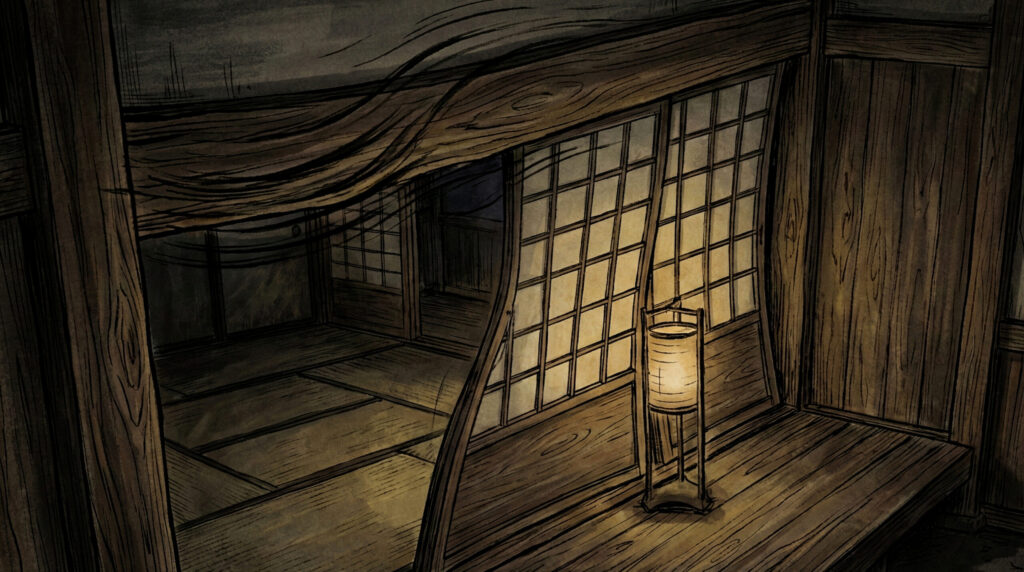
Yanari is a yōkai associated with unexplained creaking sounds in houses at night.
It represents fear generated by unseen domestic noise.
Primary Sources
Classical & Domestic Folklore Records
- Yanagita Kunio — Yōkai Dangi
- Regional household oral traditions
- Komatsu Kazuhiko — Yōkai Encyclopedia
Yanari – The House That Speaks Through Sound in Japanese Folklore
Yanari refers to unexplained sounds within a house—creaks, knocks, groans, and murmurs—that suggest the dwelling itself has become aware. Unlike roaming yōkai, Yanari does not appear. It resonates.
It does not show itself.
It does not move rooms.
It makes the house answer.
Yanari embodies habitation turned voice.
Origins in Lived Architecture and Nighttime Silence
Traditional Japanese houses—wooden frames, paper walls, shifting foundations—were living structures that breathed with weather and time. At night, when human activity ceased, sound carried meaning.
Yanari emerged to explain moments when a house seemed to respond: a knock after silence, a creak at the wrong time, a rhythm that felt intentional.
The house was not settling.
It was speaking.
From Structure to Presence
Where Komi binds awareness to trees and Suisei to water, Yanari binds awareness to inhabited space. It marks the point at which a building transitions from shelter to presence.
A house remembers footsteps.
It learns voices.
It repeats them as sound.
Sound Without Source
Yanari manifests primarily through acoustics:
Footsteps where no one walks
Knocks from walls or ceilings
Sliding sounds without movement
Whispers mistaken for wind
Attempts to locate the source fail. The sound belongs to the house as a whole.
The building answers as one body.
Behavior: Attention Through Disturbance
Yanari does not attack or possess. Its behavior is limited and persistent:
Sounds occur late at night
They repeat with irregular rhythm
They intensify when acknowledged
They subside when ignored
The interaction is subtle—attention feeds it.
Listening is participation.
Relationship with Residents
Historically, households responded to Yanari with restraint:
Avoiding unnecessary noise at night
Offering prayers or quiet acknowledgment
Checking for disrespect or neglect of the home
Yanari was treated as a sign—not of invasion, but of imbalance.
The house requests care.
Yanari Among Household Phenomena
Yanari occupies a foundational layer of domestic yōkai:
- Yanari – the house speaks
- Tsukumogami – objects awaken
- Zashiki-warashi – the house hosts
- Ashiarai-yashiki – the house reacts
It is the first whisper before manifestation.
Symbolism and Themes
Architecture as Memory
Structures retain presence.
Sound as Communication
Noise conveys intent.
Domestic Uncanny
Safety becomes uncertain.
Attention as Catalyst
Listening activates meaning.
Related Concepts
Household Sound Yōkai
Yōkai known through domestic creaking and unexplained noises.
Invisible Domestic Presence
Spirits inhabiting unseen household space.
Auditory Domestic Anxiety
Fear produced by unexplained household sounds.
Yanari in Folklore Memory
Yanari appears in records and oral tales as a common yet unsettling experience. Its familiarity grants credibility—many have heard it, few explain it.
The fear lies in recognition:
this is my house.
Modern Cultural Interpretations

This blade symbolizes unseen presence and auditory domestic anxiety.
It visualizes fear created through sound within private space.
Modern interpretations often view Yanari as a metaphor for domestic anxiety — stress embedded in living space, surfacing as sound when silence falls.
Psychologically, Yanari represents the projection of unease onto familiar structures. Walls, floors, and beams become vessels for unspoken tension, turning ordinary noises into emotional signals.
In some modern visual reinterpretations, Yanari manifests as a yōtō — a blade that resonates rather than cuts. The sword hums within enclosed spaces, translating emotional residue into audible presence. Its danger is not violence, but the amplification of unease.
Yanari persists because homes still absorb human life.
Modern Reinterpretation – Yanari as a Contemporary Yokai
In this reinterpretation, Yanari is no longer treated as a simple house spirit, but as an acoustic memory of domestic life — a presence formed by accumulated emotion within living space.
Historically, it manifests as unexplained sounds within homes. In modern life, this logic appears as emotional residue: stress absorbed by rooms, habits impressed into structures, and silence that carries weight.
The “beautiful girl” form represents the softened face of resonance — calm, familiar, and therefore easily overlooked. She does not intrude. She echoes.
Her still posture embodies response without speech — the quiet certainty that something within the house is answering.
In this visual reinterpretation, Yanari becomes the personification of living space memory — a yokai that unsettles not through violence, but through resonance.
Musical Correspondence
The accompanying track translates architectural memory into sound. Low knocks, wooden creaks, and irregular rhythmic fragments simulate domestic response.
Patterns repeat just enough to imply intention without clarity, while silence frames sound as presence.
Together, image and sound form a unified reinterpretation layer — not as folklore illustration, but as a contemporary myth of echoing homes rendered through audiovisual texture.
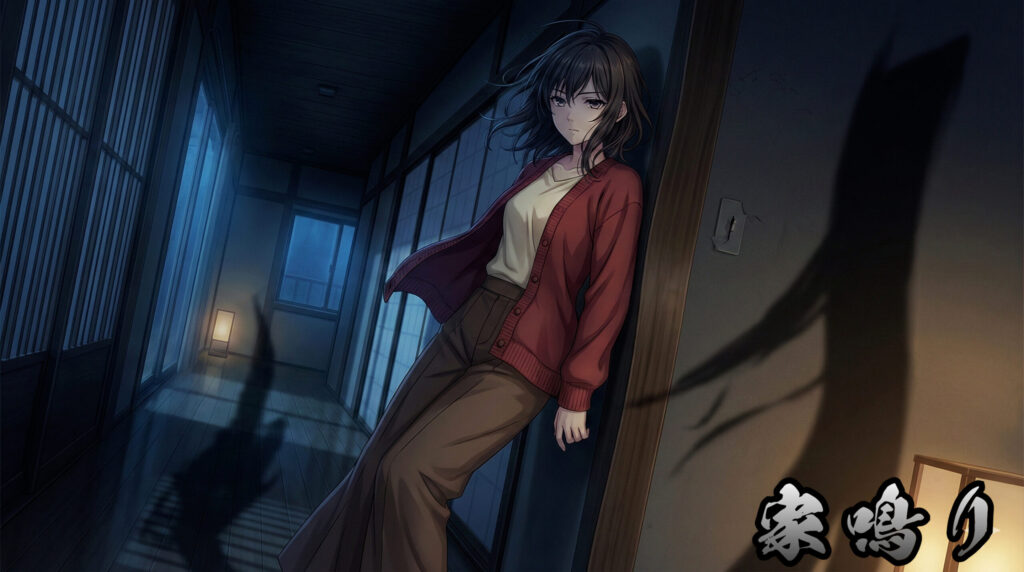
This contemporary form represents domestic sound disturbance.
She embodies unseen presence and nighttime anxiety.
Dreamy and stylish
Genre: Ritual Japanese HipHop / Darkwave Folklore Produced by: Phantom Tone | Suno AI | Kotetsu Co., Ltd. Tags: #JapaneseHipHop #AIgeneratedMusic #Yokai #Phant…