
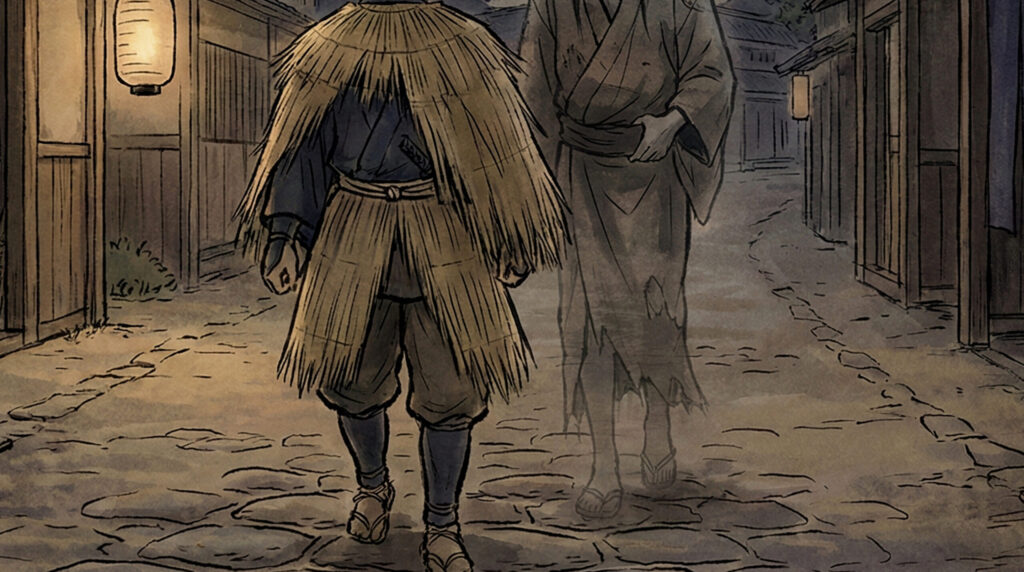
Ushirogami is a yōkai that follows travelers from behind.
It represents fear of unseen pursuit and backward anxiety.
Primary Sources
Classical & Regional Folklore Records
- Yanagita Kunio — Yōkai Dangi
- Regional village oral traditions
- Komatsu Kazuhiko — Yōkai Encyclopedia
Ushirogami – The Presence Behind You in Japanese Folk Belief
Ushirogami(後神) refers to a folkloric concept centered on a presence that appears behind a person, often without form, voice, or direct interaction. Rather than a clearly personified yokai, ushirogami functions as a phenomenological anomaly, defined by position and perception: something that is there precisely because it is not seen.
This concept draws on deeply rooted anxieties surrounding blind spots, vulnerability, and the fear of being watched, positioning ushirogami within the broader framework of Japanese folk beliefs about perception and danger.
The Back as a Zone of Vulnerability
In Japanese folk thought, the human body is not uniformly protected. The front—associated with vision, intention, and social interaction—is active and controlled. The back, by contrast, is unseen and unguarded.
Ushirogami are said to manifest specifically in this blind zone:
- Standing just outside the field of vision
- Felt rather than seen
- Known through instinctive fear rather than evidence
The threat is not attack, but awareness of exposure.
Ushirogami as a Perceptual Anomaly
Accounts involving ushirogami rarely describe physical action. Instead, they emphasize sensation:
- A sudden chill or pressure
- The feeling of breath or weight behind one’s neck
- An overwhelming urge not to turn around
This restraint is central. To look is to acknowledge, and acknowledgment risks collapse of the boundary between safety and fear. Ushirogami thus exist in a state sustained by non-confirmation.
Relationship to Sight, Sound, and Silence
Ushirogami are associated less with sound or movement than with absence of sensory input. Silence amplifies their presence. Darkness intensifies it, but even in daylight, the impossibility of seeing one’s own back sustains unease.
In this sense, ushirogami are not entities that intrude upon the senses, but anomalies that exploit their limits.
Distinction from Spirits and Yokai
Ushirogami differ markedly from other supernatural categories.
- Yūrei appear visually and narratively
- Onryō pursue targets with intent
- Shadow anomalies externalize form
Ushirogami do none of these. They are positional, not personal. They have no story, no identity, and no objective beyond presence.
Symbolism and Cultural Meaning
Fear Without Object
Ushirogami represent fear before form—the sensation of danger without cause. This aligns with folk logic that treats fear itself as meaningful data.
Discipline of Awareness
Warnings about what lies behind encourage vigilance. Ushirogami function as informal behavioral regulators, discouraging reckless movement or inattentiveness.
The Irreversibility of Recognition
To turn and see would be to transform the unknown into something defined. Ushirogami exist only as long as the boundary of ignorance holds.
Related Concepts
Backward-Watching Spirits
Yōkai associated with fear of unseen following presence.
Roadside & Traveler Yōkai
Spirits encountered during travel.
Psychological Pursuit Anxiety
Fear of being followed or watched from behind.
Regional Expressions and Oral Transmission
References to ushirogami appear in scattered regional expressions rather than canonical texts. They often surface in admonitions to children or travelers, reinforcing their role as experiential knowledge rather than narrative myth.
Their lack of standardized imagery suggests that ushirogami were never meant to be visualized—only felt.
Modern Cultural Interpretations

This blade symbolizes unseen pursuit and psychological pressure.
It visualizes fear that follows silently.
In contemporary contexts, ushirogami are frequently reinterpreted through:
- psychological anxiety,
- hypervigilance,
- the fear of unseen surveillance.
While modern language reframes the experience, the underlying structure remains unchanged: a presence defined by the impossibility of confirmation. Something is felt, reacted to, and accounted for — yet never directly verified.
In some modern visual reinterpretations, ushirogami manifest as a yōtō — a blade that refuses to be seen head-on. Its presence is registered only through reflection, shadow, or the sensation of being followed. The sword does not attack; it watches.
Ushirogami persist because uncertainty still governs fear.
Modern Reinterpretation – Ushirogami as a Contemporary Yokai
In this reinterpretation, Ushirogami is no longer treated as a shadowy pursuer, but as a perceptual anomaly — a presence that exists only because it cannot be confirmed.
Historically, it is felt rather than seen. In modern life, this logic appears as hypervigilance, unseen surveillance, and the psychological weight of being potentially observed.
The “beautiful girl” form represents the softened face of uncertainty — calm, neutral, and therefore difficult to interpret. She does not appear. She suggests.
Her quiet posture embodies fear without object — the unsettling certainty that something may be present, even when nothing can be seen.
In this visual reinterpretation, Ushirogami becomes the personification of unconfirmed presence — a yokai that unsettles not through pursuit, but through possibility.
Musical Correspondence
The accompanying track translates anticipatory fear into sound. Long drones and near-silence establish suspended expectation, while minimal melodic movement resists resolution.
Subtle textural shifts simulate approach without arrival.
Together, image and sound form a unified reinterpretation layer — not as folklore illustration, but as a contemporary myth of unverified presence rendered through audiovisual restraint.
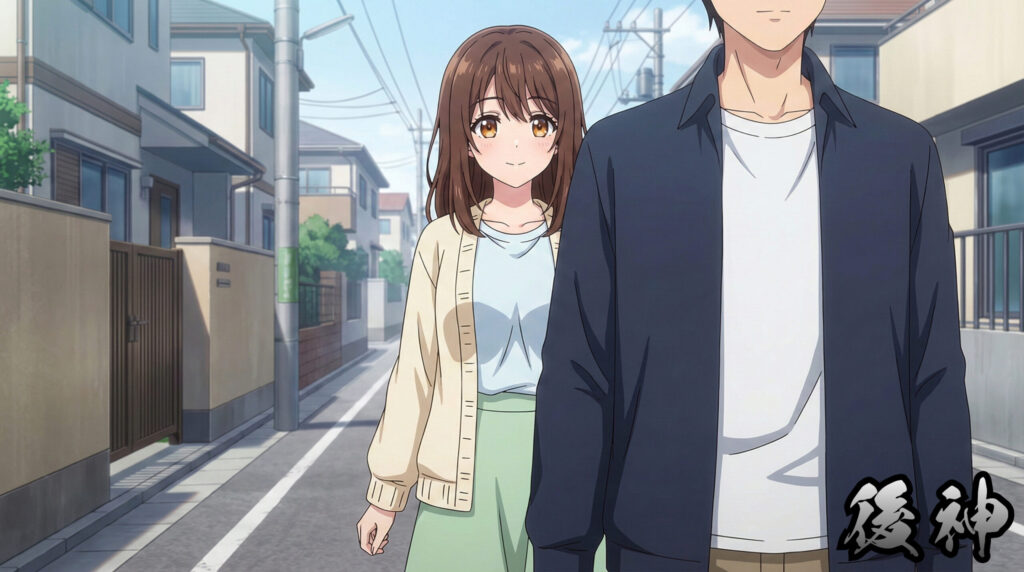
This contemporary form represents unseen following and silent presence.
She embodies pursuit anxiety and backward fear.
Dreamy and stylish
Genre: Ritual Japanese HipHop / Darkwave Folklore Produced by: Phantom Tone | Suno AI | Kotetsu Co., Ltd. Tags: #JapaneseHipHop #AIgeneratedMusic #Yokai #Phant…