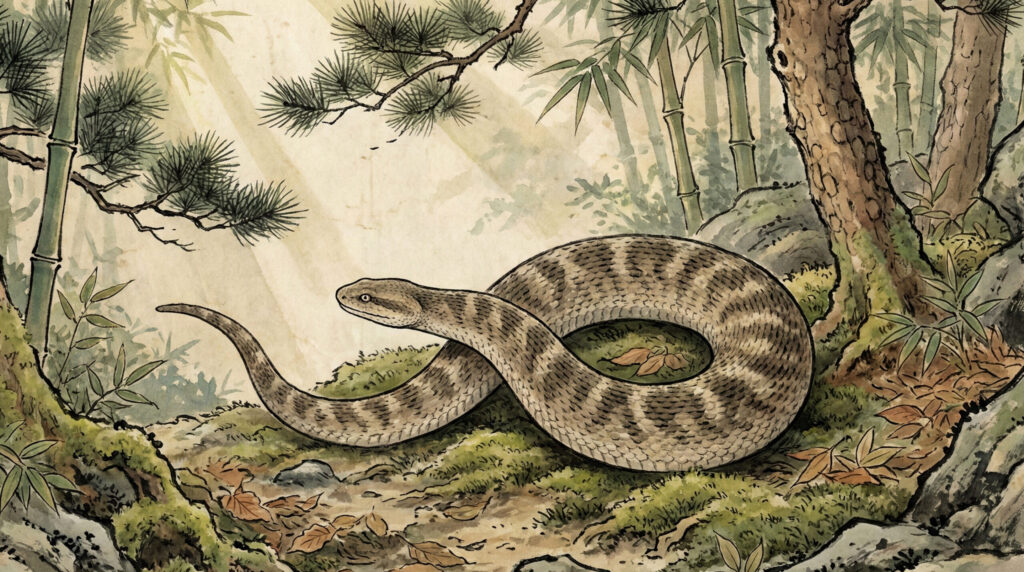
Tsuchinoko is a cryptid-like yōkai said to inhabit rural mountain areas.
It represents fear and curiosity surrounding hidden creatures.
Primary Sources
Classical & Regional Folklore Records
- Regional mountain village oral traditions
- Yanagita Kunio — Yōkai Dangi
- Komatsu Kazuhiko — Yōkai Encyclopedia
Tsuchinoko – A Folk Anomaly Reframed Beyond Cryptid Lore in Japanese Tradition
Tsuchinoko(ツチノコ) is often discussed in modern contexts as a cryptid or UMA (Unidentified Mysterious Animal). However, when examined through the lens of Japanese folklore, tsuchinoko is more accurately understood as a folk anomaly (民俗怪異)—a phenomenon shaped by regional belief, narrative transmission, and symbolic interpretation rather than zoological classification.
Rather than asking whether tsuchinoko “exists” as an undiscovered species, traditional accounts are concerned with how it is encountered, remembered, and interpreted. This places tsuchinoko firmly within the realm of folkloric thought, not speculative biology.
Early Descriptions and Folk Records
References to tsuchinoko-like creatures appear sporadically in regional records, oral traditions, and Edo-period writings. These descriptions are inconsistent in detail but share several recurring elements:
- A short, thick-bodied form, sometimes described as wider at the center
- Serpentine movement combined with sudden, unusual motion
- Appearance in rural or mountainous environments
Crucially, these accounts rarely attempt precise measurement or classification. The tsuchinoko is described as encountered, not cataloged—suggesting that its folkloric function lies in experience rather than taxonomy.
Tsuchinoko as a Folk Anomaly, Not a Hidden Species
The modern framing of tsuchinoko as a UMA applies a scientific expectation to a pre-scientific concept. In traditional contexts, tsuchinoko were not mysteries awaiting resolution, but irregular presences that disrupted ordinary perception.
Folk anomalies differ from monsters in that they do not require intention or hostility. Tsuchinoko do not stalk, punish, or teach. They appear briefly, behave strangely, and vanish—leaving uncertainty behind.
This pattern aligns closely with other Japanese folk anomalies, where the emphasis is placed on witness experience and narrative circulation, not objective verification.
Behavior and Narrative Function
Accounts often emphasize tsuchinoko’s odd movement or unexpected behavior:
- Leaping or rolling rather than slithering
- Producing sounds or sudden motion
- Appearing momentarily before disappearing
These traits destabilize expectations of familiar animals, turning the ordinary landscape into a site of anomaly. The tsuchinoko’s role is thus not to threaten, but to interrupt certainty.
Distinction from Yokai and Spirits
While tsuchinoko are frequently labeled as yokai in popular media, traditional belief places them closer to borderline phenomena than to personified beings.
- They lack names, personalities, or motives
- They do not engage with humans beyond brief appearance
- They are not moral agents
This positions tsuchinoko between natural creature and supernatural sign—a hallmark of folk anomaly rather than yokai proper.
Symbolism and Cultural Meaning
Distrust of the Familiar
Tsuchinoko embody unease toward what appears known but behaves incorrectly. A snake that moves “wrong” becomes something else entirely.
Rural Knowledge and Oral Authority
Because tsuchinoko accounts are transmitted orally, credibility rests not on proof but on who saw it. This reinforces communal knowledge over external validation.
Ambiguity as Value
The tsuchinoko’s power lies in its unresolved status. Once explained definitively, it would lose its folkloric role. Ambiguity is not a flaw—it is the point.
Related Concepts
Cryptid-Type Yōkai
Elusive creatures between folklore and cryptid lore.
Mountain & Rural Boundary Spirits
Entities inhabiting hidden natural spaces.
Discovery & Verification Anxiety
Fear and fascination surrounding unconfirmed creatures.
Modern Cultural Interpretations

This blade symbolizes hidden life, secrecy, and elusive presence.
It visualizes what resists discovery and proof.
In contemporary Japan, tsuchinoko are frequently repackaged as:
- cryptids to be captured,
- mascots or novelty creatures,
- subjects of scientific curiosity.
While culturally playful, these reinterpretations flatten the original folkloric function of tsuchinoko as experience-based anomaly. Traditional folk logic does not ask “What is it?” but instead asks, “What did you see, and how did it behave?”
In some modern visual reinterpretations, tsuchinoko manifest as a yōtō — a blade that resists classification. The sword appears subtly misshapen, its balance and curve never quite standard. It cannot be cataloged by type alone; its threat lies in unpredictability rather than power.
Tsuchinoko persist because anomalies do not disappear — they are merely repackaged.
Modern Reinterpretation – Tsuchinoko as a Contemporary Yokai
In this reinterpretation, Tsuchinoko is no longer treated as a cryptid to be proven, but as an experiential anomaly — a presence defined by encounter rather than classification.
Historically, folk accounts describe sudden, unstable movement and inconsistent shape. In modern life, this logic appears as phenomena that resist documentation: glitches, fleeting signals, and irregular events that vanish before they can be named.
The “beautiful girl” form represents the softened face of anomaly — familiar, quiet, and therefore easily dismissed. She does not prove. She appears.
Her slightly asymmetrical silhouette embodies instability — the quiet certainty that something is present, yet refuses to settle into form.
In this visual reinterpretation, Tsuchinoko becomes the personification of unresolved anomaly — a yokai that unsettles not through threat, but through uncertainty.
Musical Correspondence
The accompanying track translates unstable presence into sound. Irregular rhythms and sudden jumps simulate erratic motion and fleeting contact.
Motifs appear briefly and vanish without development, mirroring encounters that resist closure.
Together, image and sound form a unified reinterpretation layer — not as folklore illustration, but as a contemporary myth of unclassifiable presence rendered through audiovisual language.
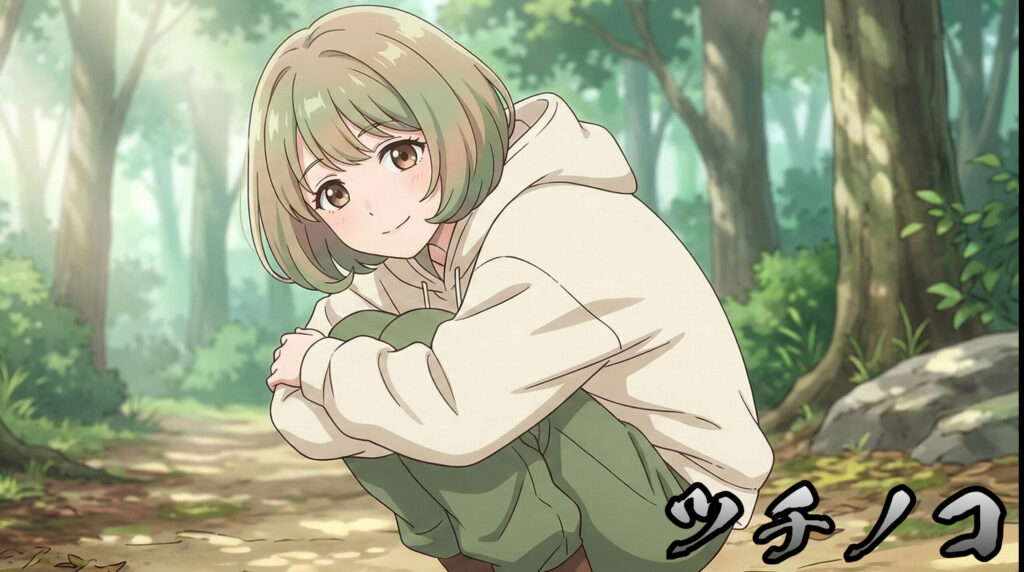
This contemporary form represents mystery and hidden existence.
She embodies cryptid anxiety and fascination.
Dreamy and stylish
Genre: Ritual Japanese HipHop / Darkwave Folklore Produced by: Phantom Tone | Suno AI | Kotetsu Co., Ltd. Tags: #JapaneseHipHop #AIgeneratedMusic #Yokai #Phant…