
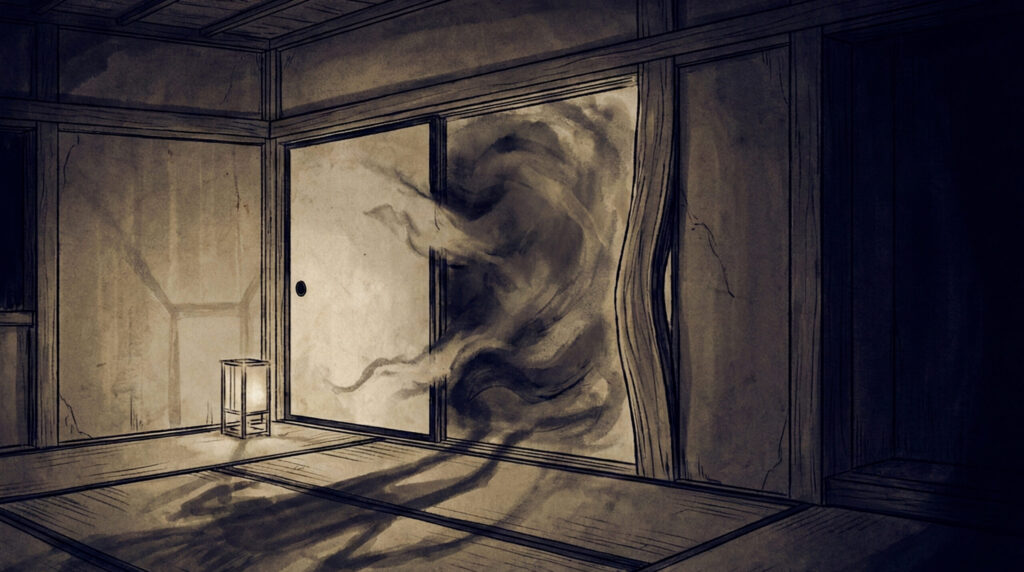
Tokakushi refers to legends of people or villages disappearing without trace.
It represents fear of social erasure and forgotten places.
Primary Sources
Classical Disappearance Lore
- Yanagita Kunio — Tōno Monogatari
- Regional village disappearance records
- Komatsu Kazuhiko — Yōkai Encyclopedia
Tokakushi – The Disappearance of Doors and the Loss of Threshold in Japanese Folklore
Tokakushi refers to a phenomenon in Japanese folklore in which doors, sliding panels, or entrances within a house suddenly vanish, refuse to open, or lead somewhere other than where they should. It is not the removal of a physical object, but the collapse of spatial certainty.
Nothing breaks.
Nothing moves.
The threshold simply fails.
Tokakushi embodies the moment when architecture withdraws its agreement with human use.
Origins in Architecture, Boundaries, and Belief
Traditional Japanese dwellings were constructed with movable boundaries: sliding doors (fusuma), paper screens (shōji), and removable partitions. These elements created a flexible interior but also produced ambiguity—rooms were defined by agreement rather than fixed walls.
Tokakushi emerges from this architectural reality combined with folk belief. When boundaries are mutable, they can also refuse.
The house is not sealed.
It negotiates.
From Physical Space to Liminal Event
Tokakushi is not merely a trick of perception. In folklore accounts, witnesses often insist that the layout was familiar, the route habitual, and the action deliberate.
A door that was always there is gone.
A passage leads nowhere.
An exit fails to function as an exit.
This marks Tokakushi as a liminal event, not an illusion.
Distinction from Related Phenomena
Tokakushi must be carefully distinguished from similar concepts:
- Unlike Kamikakushi, no person vanishes
- Unlike Yanari, no sound initiates the event
- Unlike Mayoikomi, disorientation is localized and architectural
Tokakushi targets the interface, not the occupant.
The human remains.
The doorway does not.
Appearance: Absence as Manifestation
Tokakushi manifests through absence rather than form:
A door that cannot be found
A panel that slides endlessly without opening
A room that should connect but does not
An entrance that returns the person inside
The house presents continuity, while denying transition.
The space looks intact.
Function is missing.
Behavior: Suspension of Passage
Tokakushi does not trap violently. Its effect is procedural:
Attempts to exit repeat
Time seems to stretch
Panic increases without cause
Resolution occurs suddenly, without explanation
Often, the door returns once attention shifts or calm is restored.
The house resumes cooperation.
Relationship with Residents
Historically, Tokakushi was interpreted as a sign of imbalance:
Disrespect toward the house
Neglect of ritual or cleanliness
Improper behavior at night
Emotional disturbance within the household
The response was restraint, purification, or waiting—never force.
Forcing the door worsens the state.
Tokakushi in Folk Ontology
Within household folklore, Tokakushi occupies a precise role:
- Yanari – the house speaks
- Tokakushi – the house refuses passage
- Zashiki-warashi – the house hosts
- Tsukumogami – the house awakens objects
Tokakushi represents withdrawal, not aggression.
Symbolism and Themes
Threshold as Contract
Passage requires consent.
Architecture as Active Agent
Buildings participate.
Loss of Exit
Safety depends on function, not form.
Psychological and Spatial Overlap
Emotion affects space.
Related Concepts
Hidden Village Legends
Myths of entire communities vanishing.
Liminal Space Myths
Folklore associated with boundary disappearance.
Collective Memory Loss
Fear of social erasure and forgotten places.
Tokakushi in Folklore Records
Mentions of Tokakushi appear sporadically in regional accounts and later yōkai compendia, often framed as inexplicable but temporary domestic incidents.
The key feature is recovery without repair.
Nothing was fixed.
Nothing was changed.
Yet passage returned.
Modern Cultural Interpretations

This blade symbolizes erasure, disappearance, and loss of collective memory.
It visualizes quiet removal rather than violent destruction.
Modern readings approach Tokakushi cautiously. While some explanations lean toward stress-induced disorientation, folkloric logic frames the phenomenon externally — the space itself becomes unreliable rather than the mind alone.
In architectural psychology, Tokakushi resonates with the fear of non-functional space: environments that appear ordinary, yet fail under use, mislead movement, or quietly erase orientation.
In some modern visual reinterpretations, Tokakushi manifests as a yōtō — a blade that warps direction. The sword bends pathways rather than bodies, subtly shifting angles and distances so that escape feels available while remaining unreachable. Its danger lies in misalignment rather than force.
Tokakushi persists because architecture still governs behavior.
Modern Reinterpretation – Tokakushi as a Contemporary Yokai
In this reinterpretation, Tokakushi is no longer treated as a vanishing house anomaly, but as a spatial refusal — the moment when architecture withdraws cooperation.
Historically, familiar doors and passages cease to function as expected. In modern life, this logic appears as disorienting layouts, misleading navigation systems, and spaces that quietly deny movement without appearing broken.
The “beautiful girl” form represents the softened face of spatial denial — calm, neutral, and therefore rarely suspected. She does not block. She redirects.
Her composed posture embodies misalignment — the quiet certainty that movement is possible, yet unreachable.
In this visual reinterpretation, Tokakushi becomes the personification of spatial refusal — a yokai that unsettles not through violence, but through misdirection.
Musical Correspondence
The accompanying track translates denied passage into sound. Familiar motifs begin but fail to conclude, simulating withheld resolution.
Stalled rhythms and looping harmonic progressions mirror motion that never arrives.
Together, image and sound form a unified reinterpretation layer — not as folklore illustration, but as a contemporary myth of uncooperative space rendered through audiovisual language.
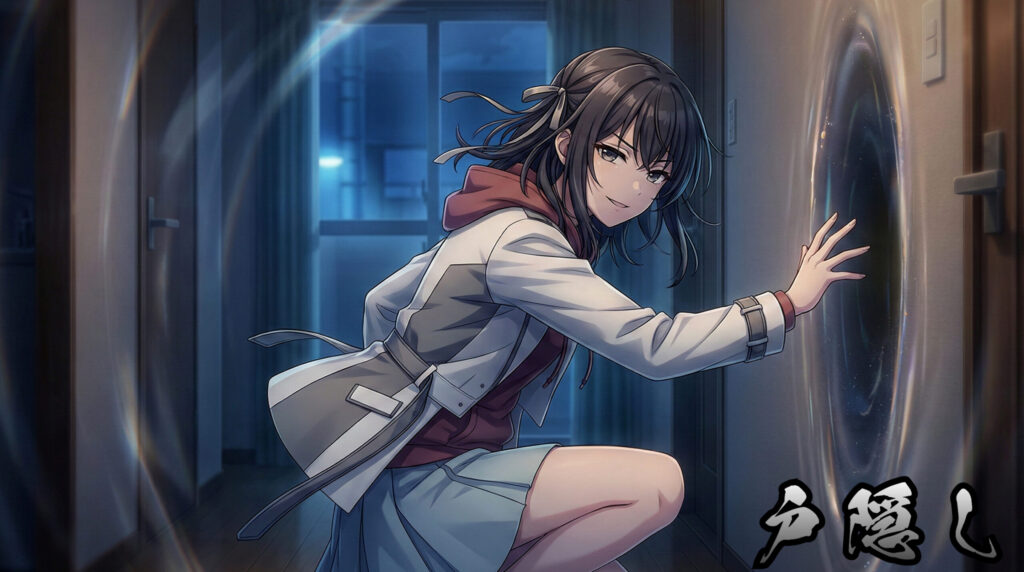
This contemporary form represents disappearance and forgotten identity.
She embodies social erasure and liminal absence.
Dreamy and stylish
Genre: Ritual Japanese HipHop / Darkwave Folklore Produced by: Phantom Tone | Suno AI | Kotetsu Co., Ltd. Tags: #JapaneseHipHop #AIgeneratedMusic #Yokai #Phant…