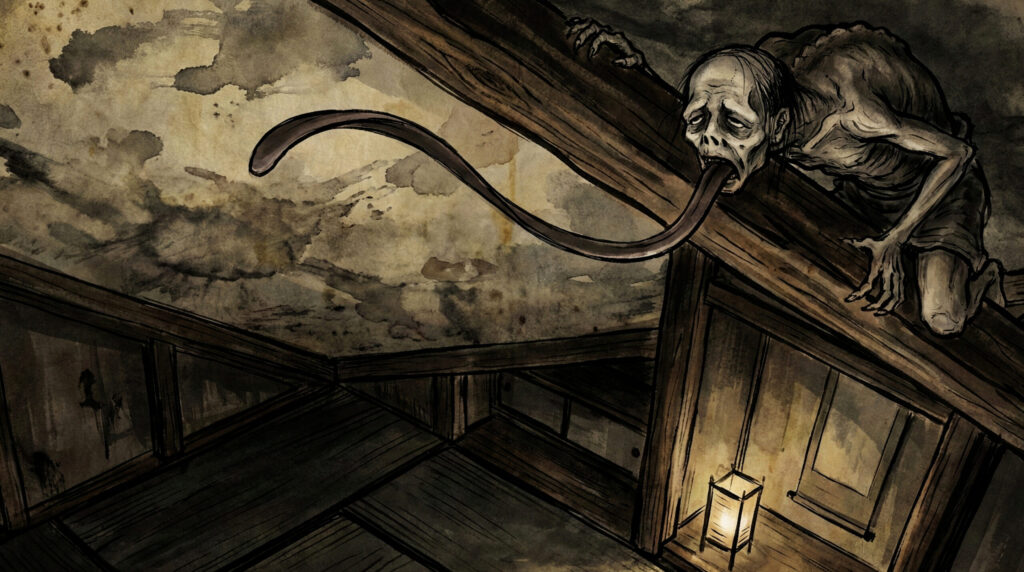
Tenjoname is a yōkai said to lick dirty ceilings at night.
It represents fear of overhead neglect and unseen domestic presence.
Primary Sources
Edo-Period Illustrated Encyclopedias
- Gazu Hyakki Yagyō (画図百鬼夜行) — Toriyama Sekien
- Konjaku Hyakki Shūi (今昔百鬼拾遺) — Toriyama Sekien
Classical Folklore References
- Yanagita Kunio — Yōkai Dangi
- Komatsu Kazuhiko — Yōkai Encyclopedia
Tenjoname – The Yōkai That Invades the Uppermost Boundary of the Home in Japanese Folklore
Tenjoname is a household yōkai said to lick the ceilings of houses, leaving behind dark stains and an unsettling sense of violation. Unlike entities that approach from outside or ground level, Tenjoname targets the highest interior boundary—a space rarely watched and rarely defended.
It does not descend.
It does not announce itself.
It reaches where humans do not look.
Tenjoname embodies intrusion from above.
Origins in Ceiling Space and Architectural Blind Spots
Traditional Japanese houses often concealed their upper structures: beams, rafters, and ceiling panels separated daily life from unused, shadowed space. This upper zone was functionally invisible—out of sight, out of reach.
Tenjoname emerges from anxiety tied to this blind spot. What is unseen above is imagined as vulnerable, neglected, and receptive to intrusion.
The floor is watched.
The walls are touched.
The ceiling is forgotten.
From Surface Violation to Vertical Intrusion
Where Shojiname violates boundaries at eye level, Tenjoname escalates the threat vertically.
The home is no longer touched where humans pass.
It is marked where humans cannot intervene.
This marks a progression in household yōkai: intrusion moving upward, toward absolute vulnerability.
Appearance: Rarely Witnessed, Physically Evident
Tenjoname is almost never seen directly. Its presence is inferred through aftermath:
Dark, damp stains spreading on ceilings
Discoloration that cannot be scrubbed away
A sense of heaviness when looking upward
Unease triggered by noticing the mark
The act is intimate yet unreachable.
You see the trace.
You cannot confront the cause.
Behavior: Contamination Without Encounter
Tenjoname does not enter rooms visibly, nor does it interact with occupants:
It licks but does not descend
It stains but does not destroy
It marks but does not return immediately
It withdraws before being noticed
The intrusion is complete before awareness begins.
The house is altered silently.
Relationship with Residents
Traditional responses emphasize purification and acknowledgment rather than pursuit:
Cleaning rituals
Replacing ceiling panels
Burning incense or offering prayers
Reexamining household order and neglect
Tenjoname is interpreted as a symptom of imbalance—spiritual or domestic.
The ceiling reflects disorder below.
Tenjoname in Household Ontology
Within domestic yōkai classification, Tenjoname occupies a precise role:
- Yanari – the house speaks
- Tokakushi – the house refuses
- Ashiarai Yashiki – the house commands
- Shojiname – the house is touched
- Tenjoname – the house is contaminated above
It represents upper-boundary violation.
Symbolism and Themes
Vertical Vulnerability
Threats descend from unseen space.
Neglected Boundaries
What is not watched is marked.
Contamination Over Force
Damage without confrontation.
Domestic Guilt
Neglect manifests physically.
Related Concepts
Ceiling Spirits
Yōkai inhabiting overhead domestic space.
Household Filth Yōkai
Yōkai associated with dirt and neglect.
Vertical Domestic Anxiety
Fear arising from overhead unseen presence.
Tenjoname in Folklore Records
Tenjoname appears in Edo-period yōkai catalogs, often illustrated stretching its tongue upward toward ceilings. Its placement among “licking yōkai” emphasizes contamination rather than violence.
The horror lies in aftermath, not action.
The mark remains.
The moment is gone.
Modern Cultural Interpretations

This blade symbolizes overhead neglect and unseen domestic intrusion.
It visualizes contamination descending from above.
Modern interpretations often frame Tenjoname as a metaphor for anxiety born from neglected responsibilities — problems that accumulate quietly above notice until they seep into everyday life.
Psychologically, Tenjoname reflects discomfort with what exists beyond direct awareness. It embodies the unease of knowing that something has been overlooked, growing steadily in places rarely checked or acknowledged.
In some modern visual reinterpretations, Tenjoname manifests as a yōtō — a blade that stains rather than slices. The sword leaves marks overhead, reminders of neglect that drip downward over time. Its threat is not immediacy, but inevitability: what is ignored will eventually descend.
Tenjoname persists because blind spots still exist.
Modern Reinterpretation – Tenjoname as a Contemporary Yokai
In this reinterpretation, Tenjoname is no longer treated as a grotesque ceiling spirit, but as a structural presence — a sign of neglect that progresses where awareness does not reach.
Historically, it licks ceilings and leaves stains as proof of passage. In modern life, this logic appears as blind spots: uninspected systems, forgotten responsibilities, and quiet failures that accumulate beyond notice.
The “beautiful girl” form represents the softened face of neglect — calm, distant, and therefore rarely questioned. She does not intrude. She remains.
Her upward gaze and quiet posture embody unseen deterioration — the unsettling certainty that something is progressing beyond awareness.
In this visual reinterpretation, Tenjoname becomes the personification of overlooked consequence — a yokai that unsettles not through attack, but through accumulation.
Musical Correspondence
The accompanying track translates overhead intrusion into sound. High-register textures hover above grounded tones, while slow descending motifs simulate quiet approach.
Suspended rhythms and subtle dissonance introduce pressure without contact.
Together, image and sound form a unified reinterpretation layer — not as folklore illustration, but as a contemporary myth of unseen progression rendered through audiovisual language.
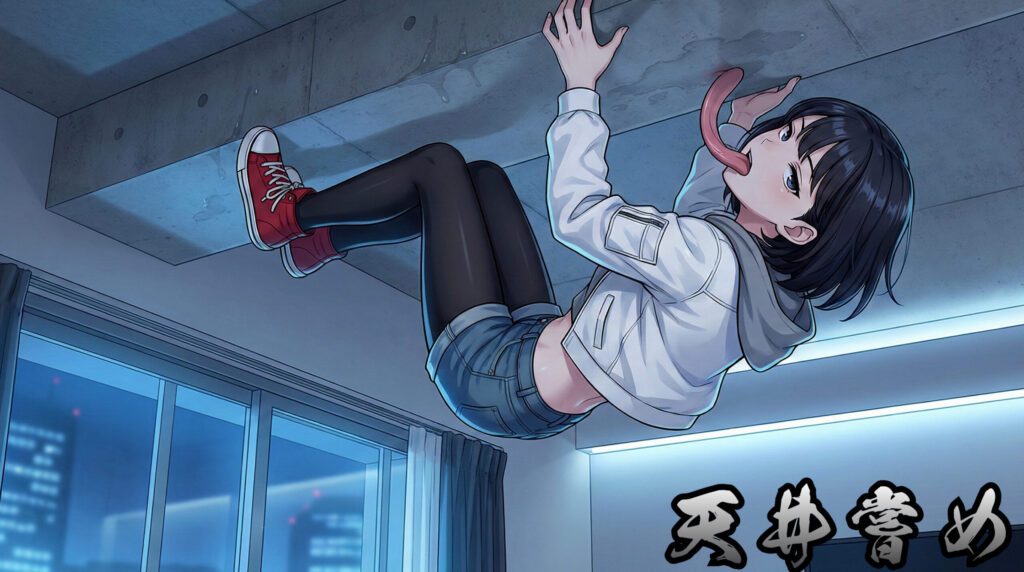
This contemporary form represents overhead presence and domestic neglect.
She embodies vertical domestic anxiety and quiet intrusion.
Dreamy and stylish
Genre: Ritual Japanese HipHop / Darkwave Folklore Produced by: Phantom Tone | Suno AI | Kotetsu Co., Ltd. Tags: #JapaneseHipHop #AIgeneratedMusic #Yokai #Phant…