
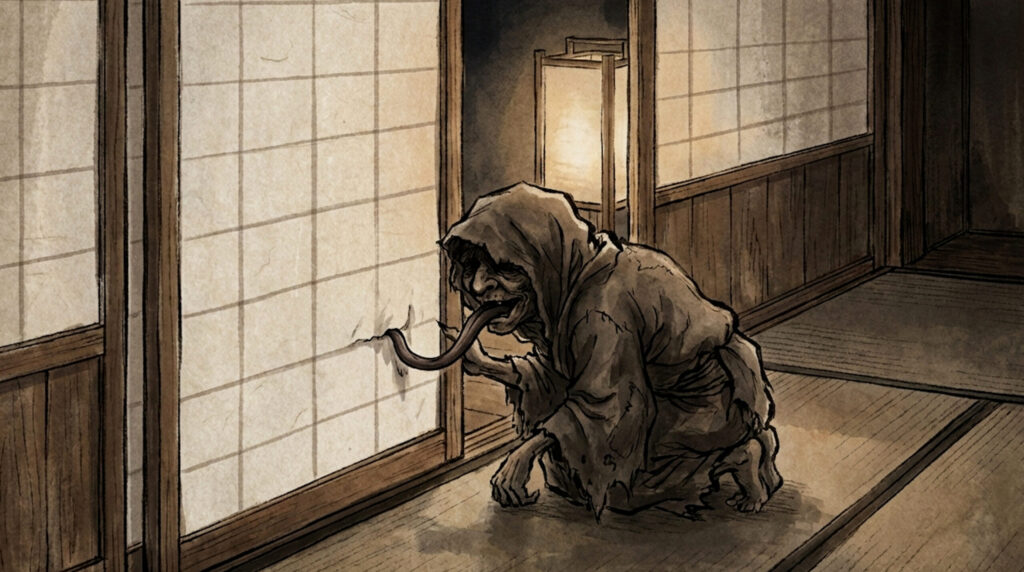
Shojiname is a yōkai known for calling travelers by name at night.
It represents fear of deceptive voices and unseen luring.
Primary Sources
Edo-Period Illustrated Encyclopedias
- Gazu Hyakki Yagyō (画図百鬼夜行) — Toriyama Sekien
- Konjaku Hyakki Shūi (今昔百鬼拾遺) — Toriyama Sekien
Classical Folklore References
- Yanagita Kunio — Yōkai Dangi
- Komatsu Kazuhiko — Yōkai Encyclopedia
Shojiname – The Yōkai That Violates the Boundary of the Home in Japanese Folklore
Shojiname is a household yōkai known for licking shōji—paper sliding screens that divide interior space in traditional Japanese houses. Unlike aggressive intruders, Shojiname does not enter fully. It violates the boundary quietly, leaving behind discomfort rather than destruction.
It does not break in.
It does not reveal itself.
It crosses by touch.
Shojiname embodies intrusion without confrontation.
Origins in Shōji as Living Boundaries
Shōji are not walls. They are semi-permeable surfaces—light passes through, sound leaks, and movement is implied rather than blocked. In folk belief, such boundaries are inherently vulnerable.
Shojiname emerges from this vulnerability. It targets the thinnest layer between safety and exposure.
The boundary exists.
But it is weak.
From House Sounds to Surface Contact
Where Yanari announces presence through sound, Tokakushi denies passage, and Ashiarai Yashiki issues command, Shojiname operates at a subtler level.
The house is not taken.
It is touched.
This marks a shift from authority to contamination.
Appearance: Rarely Seen, Immediately Known
Shojiname is almost never observed directly. Its presence is inferred through traces:
Wet streaks on shōji paper
Discoloration along the lower panels
A faint smell of saliva
Unease upon noticing marks
The act is intimate enough to disturb, yet incomplete enough to deny certainty.
You know it happened.
You did not see it.
Behavior: Boundary Violation Without Entry
Shojiname’s defining feature is restraint:
It licks but does not tear
It approaches but does not enter
It marks but does not damage
It withdraws without sound
The intent is not consumption. It is contact.
The home remains intact.
The sense of safety does not.
Relationship with Residents
Traditional responses to Shojiname emphasize purification rather than defense:
Replacing or cleaning shōji
Burning incense
Checking household cleanliness
Quiet acknowledgment of disorder
Shojiname is interpreted as a sign that boundaries—physical or moral—have weakened.
The house requires restoration.
Shojiname in Household Ontology
Within domestic yōkai classification, Shojiname occupies a precise position:
- Yanari – the house signals
- Tokakushi – the house refuses
- Ashiarai Yashiki – the house commands
- Shojiname – the house is violated
It represents invasion at the surface level.
Symbolism and Themes
Contamination Over Destruction
Damage is psychological.
Weak Boundaries
Protection without solidity.
Intimacy as Threat
Touch replaces force.
Cleanliness and Order
Impurity invites intrusion.
Related Concepts
Auditory Luring Yōkai
Yōkai that lure through sound.
Roadside Spirits
Spirits appearing near paths and bridges.
Deceptive Calling Motif
Fear associated with unseen voices.
Shojiname in Folklore Records
Shojiname appears in Edo-period yōkai catalogs and illustrations, often grouped with other “licking” yōkai. Its persistence in records suggests resonance with everyday fear rather than extraordinary terror.
The fear is domestic.
The scale is personal.
Modern Cultural Interpretations

This blade symbolizes deceptive calling and auditory entrapment.
It visualizes danger delivered through familiar voices.
Modern interpretations often read Shojiname as a metaphor for invasive presence — violations that stop short of overt harm yet leave a deep sense of disturbance. The act itself is minor, but its intimacy transforms it into something profoundly unsettling.
Psychologically, Shojiname reflects anxiety surrounding personal boundaries being breached without a visible perpetrator. The fear does not come from attack, but from proximity: the realization that something came close enough to touch without permission.
In some modern visual reinterpretations, Shojiname appears as a yōtō — a blade that never strikes directly. Its edge grazes, brushes, and intrudes, leaving no visible wound yet permanently altering one’s sense of safety. The weapon’s threat lies in contact, not force.
Shojiname persists because boundaries still fail quietly.
Modern Reinterpretation – Shojiname as a Contemporary Yokai
In this reinterpretation, Shojiname is no longer treated as a grotesque house spirit, but as a liminal intruder — a presence defined by contact rather than appearance.
Historically, it licks shōji screens, leaving stains as proof of passage. In modern life, this logic appears as boundary violations that leave no visible attacker: data breaches, privacy intrusions, and unwanted proximity.
The “beautiful girl” form represents the softened face of intrusion — gentle, quiet, and therefore difficult to identify as threat. She does not break in. She brushes.
Her calm posture embodies violation without violence — the unsettling certainty that something crossed your boundary without being seen.
In this visual reinterpretation, Shojiname becomes the personification of unseen contact — a yokai that unsettles not through force, but through proximity.
Musical Correspondence
The accompanying track translates intimate violation into sound. Close-mic textures and faint rhythmic irregularities simulate breath, moisture, and presence.
Sparse melodic fragments hover near silence, and unresolved phrases reinforce lingering unease.
Together, image and sound form a unified reinterpretation layer — not as folklore illustration, but as a contemporary myth of boundary intrusion rendered through tactile sound and restraint.
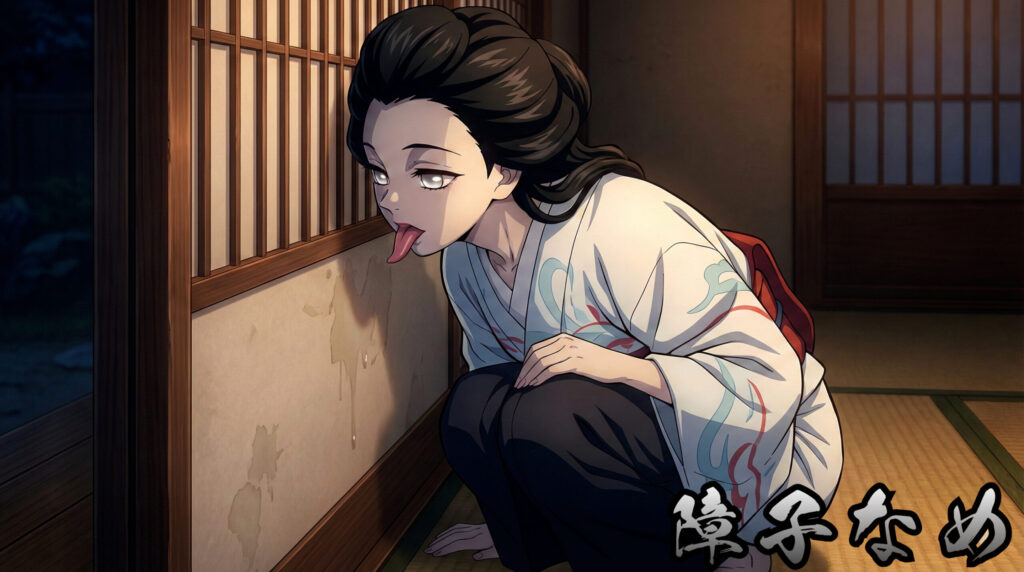
This contemporary form represents familiar voices used as traps.
She embodies auditory deception and night-road anxiety.
Dreamy and stylish
Genre: Ritual Japanese HipHop / Darkwave Folklore Produced by: Phantom Tone | Suno AI | Kotetsu Co., Ltd. Tags: #JapaneseHipHop #AIgeneratedMusic #Yokai #Phant…