
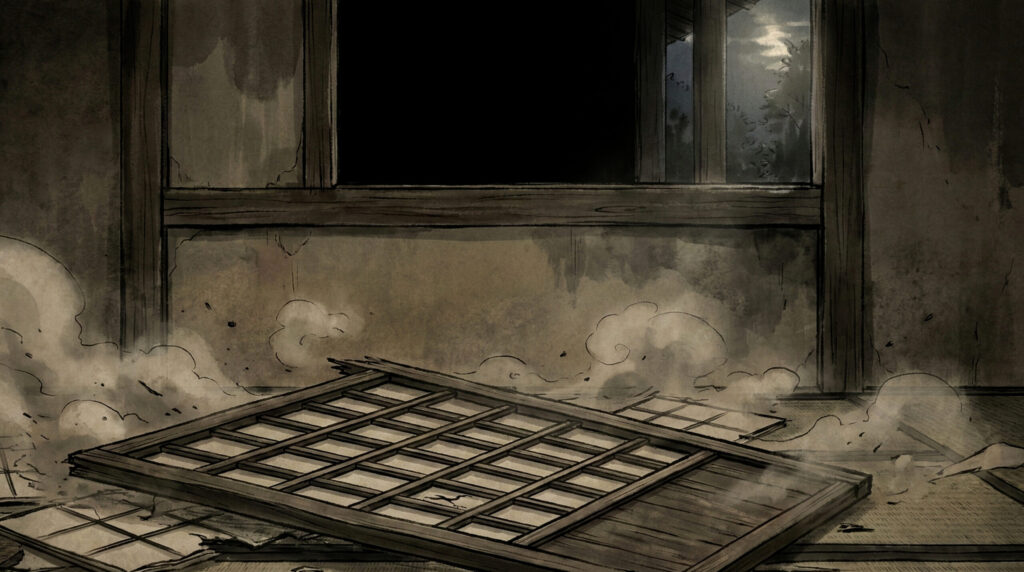
Mado-otoshi is a yōkai that drops suddenly from above onto passersby.
It represents fear of vertical ambush and unseen danger.
Primary Sources
Edo-Period Illustrated Encyclopedias
- Gazu Hyakki Yagyō (画図百鬼夜行) — Toriyama Sekien
- Konjaku Hyakki Shūi (今昔百鬼拾遺) — Toriyama Sekien
Classical Folklore References
- Yanagita Kunio — Yōkai Dangi
- Komatsu Kazuhiko — Yōkai Encyclopedia
Mado-otoshi – Architectural Anomalies at the Threshold of Home in Japanese Folklore
Mado-otoshi(窓落とし) refers to a class of supernatural disturbance associated with windows as architectural boundaries in Japanese folk belief. Rather than a fully personified yokai, mado-otoshi is best understood as a phenomenon-based anomaly, emerging where domestic architecture intersects with vulnerability, exposure, and unseen intrusion.
In traditional Japanese houses, windows were not merely openings for light and air. They were controlled breaches—points where inside and outside met. Mado-otoshi manifests when this balance fails, often described as the sudden opening, collapse, or violent disturbance of windows without visible cause.
Windows in Japanese Architectural Folklore
The Window as a Managed Boundary
Traditional Japanese architecture emphasizes permeability: sliding doors, paper screens, and adjustable openings regulate airflow, light, and social interaction. Windows (窓) are carefully positioned to mediate between the household interior and the external world.
This mediation carries symbolic weight. A window is neither entrance nor wall—it is a threshold without passage, making it uniquely prone to anomaly.
Vulnerability Without Crossing
Unlike doors, windows are not meant for passage. When something appears to cross—or act through—a window, it signals a violation of architectural intent. Mado-otoshi emerges from this violation.
Mado-otoshi as a Phenomenon, Not a Being
Accounts of mado-otoshi rarely describe a visible entity. Instead, they focus on effects:
- Sudden opening or collapse of shutters
- Loud impacts with no external trace
- Repeated disturbances at night or during storms without clear cause
The absence of a figure is essential. Mado-otoshi is not an intruder but an event, reinforcing its classification as a folk anomaly rather than a yokai with personality.
Relationship to Domestic Space and Safety
The home in Japanese belief is a protected interior, maintained through ritual cleanliness, social order, and architectural design. Mado-otoshi disrupts this protection not by entering, but by breaching the boundary without fully crossing it.
This creates a specific unease:
- The danger remains outside
- The impact is felt inside
- Responsibility cannot be assigned
Such disturbances suggest that protection has weakened, even if no rule was consciously broken.
Distinction from Other Household Yokai
Mado-otoshi must be distinguished from other domestic supernatural traditions.
- Yanari (家鳴り) involve sounds within the house structure
- Tsukumogami concern animated objects
- Yūrei appear as figures with narrative intent
Mado-otoshi is none of these. It is spatial rather than personal, tied to architectural function rather than story.
Symbolism and Cultural Meaning
Anxiety of Exposure
Mado-otoshi reflects fear of being seen, touched, or affected without consent. The window allows perception in both directions, making it a site of mutual vulnerability.
Architecture as Spiritual System
The phenomenon reinforces the idea that buildings are not inert. Correct placement, maintenance, and respect for structure are essential to spiritual stability.
Night, Weather, and Uncertainty
Many accounts associate mado-otoshi with night winds or storms—not as causes, but as conditions that heighten boundary instability.
Related Concepts
Falling-Object Yōkai
Yōkai associated with sudden vertical intrusion.
Urban & Alleyway Spirits
Spirits inhabiting narrow streets and buildings.
Nocturnal Ambush Fear
Fear of unseen threats descending from above.
Regional Variation and Oral Transmission
Descriptions of mado-otoshi vary by region, influenced by local architectural styles:
- Wooden shutters versus paper screens
- Elevated houses versus ground-level dwellings
- Mountain climates versus coastal winds
These variations underscore that mado-otoshi is architecture-dependent folklore, shaped by how people build and inhabit space.
Modern Cultural Interpretations

This blade symbolizes sudden descent, surprise attack, and vertical threat.
It visualizes danger that falls without warning.
In contemporary contexts, mado-otoshi is frequently reinterpreted as a manifestation of domestic unease — fear rooted not in open danger, but in the instability of supposedly safe, enclosed spaces.
- psychological anxiety tied to domestic insecurity,
- unease surrounding surveillance, visibility, and exposure,
- architectural failure translated into supernatural language.
These interpretations remain consistent with traditional folklore logic, which treats buildings not as neutral containers, but as active participants in lived experience — capable of remembering, responding, and failing.
In some modern visual reinterpretations, mado-otoshi manifests as a yōtō — a blade that mirrors a window frame, sharp at the threshold between inside and outside. The sword does not break walls; it exploits gaps. To draw it is to realize that exposure does not come from intrusion alone, but from structural weakness.
Mado-otoshi persists because shelter is never as absolute as it appears.
Modern Reinterpretation – Mado-otoshi as a Contemporary Yokai
In this reinterpretation, Mado-otoshi is no longer treated as a simple architectural ghost, but as a structural anomaly — the moment when shelter fails without warning.
Historically, houses functioned as protective systems. In modern life, they have become layered environments of surveillance, privacy, and perceived safety. Mado-otoshi appears not as an invader, but as a failure within this system — a breach created by structure itself.
The “beautiful girl” form represents the approachable surface of domestic security — calm, neutral, and therefore trusted. She does not intrude. She exposes.
Her silent presence embodies vulnerability hidden inside protection — the unease of realizing that danger does not always come from outside.
In this visual reinterpretation, Mado-otoshi becomes the personification of architectural failure — a yokai that unsettles not through pursuit, but through collapse of boundary.
Musical Correspondence
The accompanying track translates structural interruption into sound. Quiet, regulated passages establish domestic calm before sudden percussive impacts break containment.
Sparse textures and suspended silence simulate the moment after disturbance — sound waiting for something that never fully arrives.
Together, image and sound form a unified reinterpretation layer — not as folklore illustration, but as a contemporary myth of failing shelter rendered through audiovisual language.
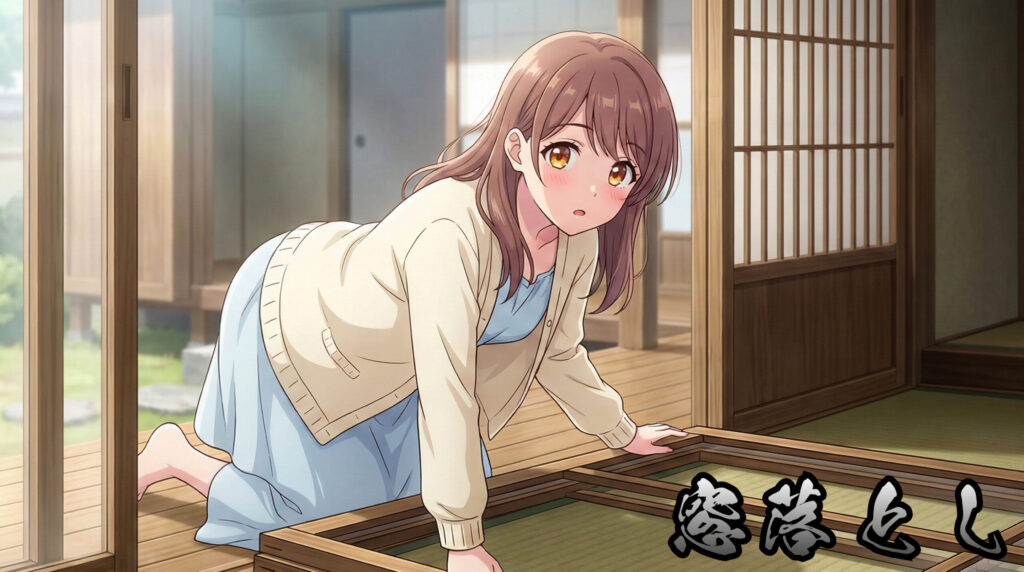
This contemporary form represents silent descent and sudden intrusion.
She embodies vertical fear and nocturnal ambush anxiety.
Dreamy and stylish
Genre: Ritual Japanese HipHop / Darkwave Folklore Produced by: Phantom Tone | Suno AI | Kotetsu Co., Ltd. Tags: #JapaneseHipHop #AIgeneratedMusic #Yokai #Phant…