
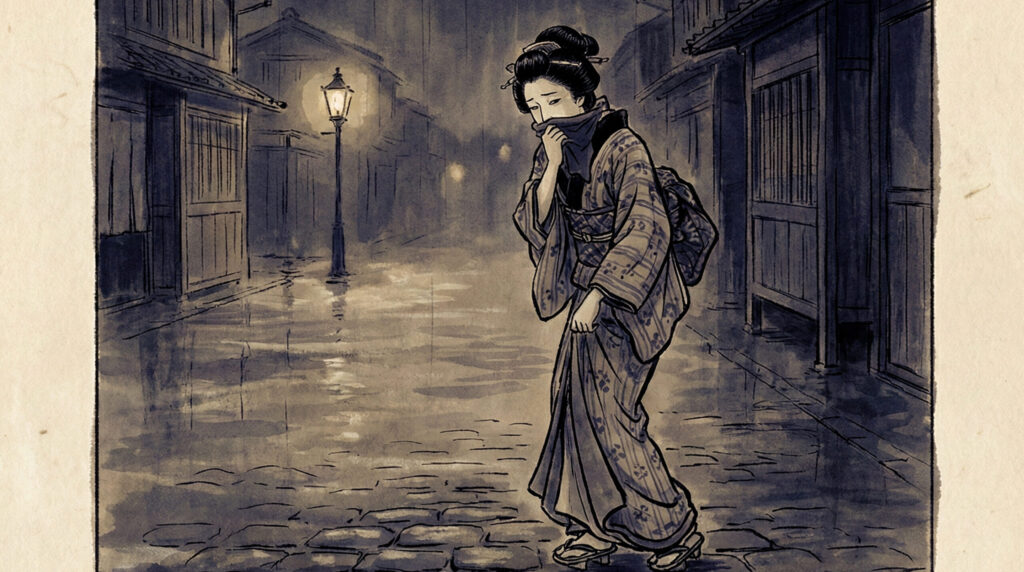
Kuchisake-onna is an urban legend yōkai associated with masked strangers and facial distortion.
It represents anxiety surrounding trust, appearance, and unknown encounters.
Primary Sources
Modern Urban Legend Sources
- Local oral transmission (post-war Japan)
- Municipal folklore records
- Komatsu Kazuhiko — Yōkai Encyclopedia
- Yanagita Kunio — Urban Folklore Studies
Kuchisake-onna – A Modern Folk Anomaly Beyond Urban Legend in Japanese Culture
Kuchisake-onna(口裂け女) is often dismissed as a sensational urban legend, particularly associated with late-20th-century moral panic. However, when examined through the framework of folklore studies, she is more accurately understood as a modern folk anomaly(現代民俗怪異)—a figure born from contemporary social conditions, transmitted through communal narrative, and shaped by lived fear rather than fictional invention.
She is not a yokai of the premodern era, nor a ghost rooted in classical religious doctrine. Instead, kuchisake-onna occupies a transitional space where traditional mechanisms of folklore continue to operate within a modern, urbanized society.
Emergence in Modern Society
The widespread circulation of kuchisake-onna narratives began in the late Shōwa period, particularly during times of rapid urban expansion and social transition. Reports described a masked woman approaching children or pedestrians and asking a deceptively simple question, followed by unpredictable consequences.
What distinguishes these accounts is not their originality, but their pattern of transmission:
- Rapid spread through schools and neighborhoods
- Regional variation with shared core structure
- Immediate behavioral responses (warnings, curfews, collective avoidance)
These traits align closely with traditional folk belief rather than fictional storytelling.
From Oral Tradition to Modern Folklore
Although mediated by newspapers, television, and rumor networks, kuchisake-onna followed the same logic as older folklore:
- The story adapts to local conditions
- Details change while structure remains
- Belief manifests through action, not proof
The use of modern elements—surgical masks, scissors, urban streets—does not weaken her folkloric status. Instead, it demonstrates that folklore updates its symbols to match contemporary reality.
Not a Yokai, Not a Ghost
Kuchisake-onna resists classical classification.
- She is not a yūrei, as she lacks funerary context or clear postmortem origin
- She is not an onryō, as her actions are not rooted in a specific grievance
- She is not a traditional yokai, lacking mythic lineage
Her power derives from anticipation and recognition. She exists because people know how to react to her presence—even if they never encounter her directly.
Mechanism of Fear and Social Function
Question as Trigger
The defining feature of kuchisake-onna is interaction. The question she poses forces immediate response, turning fear into participation. This interactive structure is rare in classical folklore but highly effective in modern contexts.
Regulation of Movement
During periods of heightened belief, children traveled in groups, schools issued warnings, and communities altered routines. Kuchisake-onna thus functioned as a temporary regulator of urban behavior, much like older boundary spirits did in rural settings.
Collective Anxiety
Rather than representing a single trauma, kuchisake-onna aggregates diffuse anxieties: fear of strangers, violence in public space, and the breakdown of assumed safety.
Symbolism and Cultural Meaning
The Mask and Concealment
The surgical mask, a mundane object, becomes uncanny. It conceals identity while inviting trust, reflecting unease toward anonymity in crowded cities.
Beauty, Deformity, and Social Judgment
Narratives often hinge on appearance and evaluation. The question is not merely threatening—it demands judgment, implicating the listener in the outcome.
Related Concepts
Urban Legend Yōkai
Modern yōkai born from city rumor and social anxiety.
Appearance & Social Trust Anxiety
Fear associated with faces, trust, and strangers.
Mask & Concealment Motifs
Hidden identity and deceptive appearance.
Modern Cultural Interpretations

This blade symbolizes hidden violence, social fear, and masked threat.
It visualizes danger concealed behind familiarity.
In modern cultural interpretations, Kuchisake-onna is understood as a distinctly urban form of liminality. She appears on streets, near schools, and during twilight hours — contemporary equivalents of crossroads, village borders, and thresholds where social supervision weakens.
Psychologically, she embodies anxiety tied to public space: moments when authority, safety, and clear social rules briefly dissolve. Her question is not merely threatening; it forces an immediate response under uncertain conditions, reflecting pressures of appearance, conformity, and fear of misjudgment.
In some modern visual reinterpretations, Kuchisake-onna manifests as a yōtō — a blade whose edge resembles a forced smile. The sword does not rush its strike; it waits for acknowledgment. To face it is to realize that hesitation itself becomes the cut, turning social interaction into a point of danger.
Kuchisake-onna persists because liminal spaces still exist — wherever oversight fades and individuals are left to answer alone.
Modern Reinterpretation – Kuchisake-onna as an Urban Liminal Yokai
In this reinterpretation, Kuchisake-onna is no longer treated as a simple urban legend, but as a structural anomaly that appears where public space loses supervision.
Historically, crossroads and village borders served as zones of weakened order. In modern society, these have become streets at dusk, school routes, convenience store alleys, and transit corridors — places where individuals are briefly left to navigate uncertainty alone.
The “beautiful girl” form represents the approachable surface of social danger — friendly, familiar, and therefore difficult to reject. She does not chase. She asks.
Her gentle posture hides a compulsory interaction: hesitation itself becomes the cut. In this visual reinterpretation, her smile is not expression — it is mechanism.
Kuchisake-onna becomes the personification of social interrogation — a yokai that enforces caution not through pursuit, but through forced response.
Musical Correspondence
The accompanying track translates urban anticipation into sound. Sparse, repeating motifs resemble footsteps on empty streets, while sudden silences simulate the pause before a question is asked.
Sharp percussive accents cut through muffled textures, evoking concealed movement and abrupt confrontation.
Together, image and sound form a unified reinterpretation layer — not as folklore illustration, but as a contemporary myth of social anxiety rendered through audiovisual language.
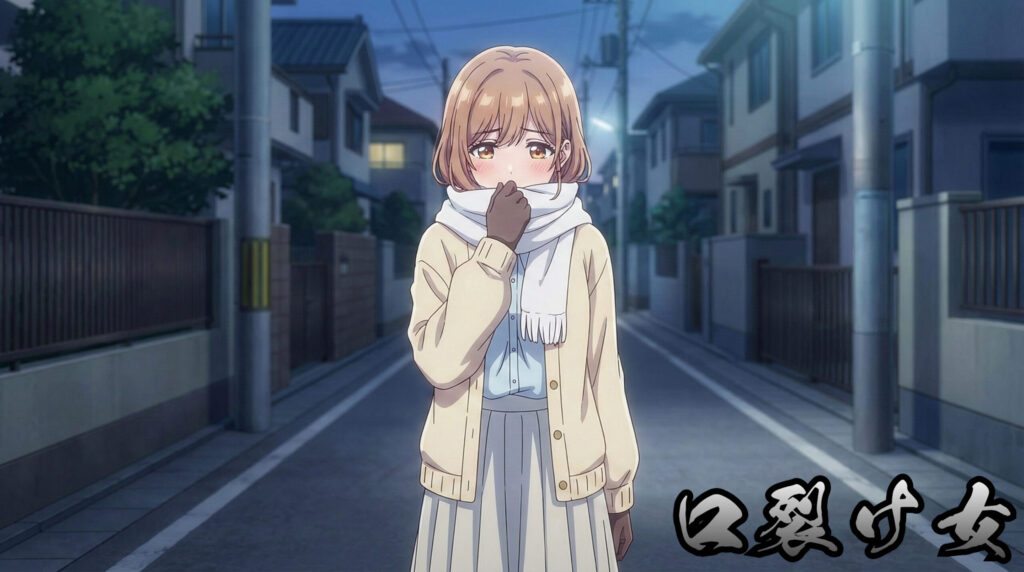
This contemporary form represents facial concealment, distrust, and urban paranoia.
She embodies fear generated by strangers and appearance anxiety.
Dreamy and stylish
Genre: Ritual Japanese HipHop / Darkwave Folklore Produced by: Phantom Tone | Suno AI | Kotetsu Co., Ltd. Tags: #JapaneseHipHop #AIgeneratedMusic #Yokai #Phant…