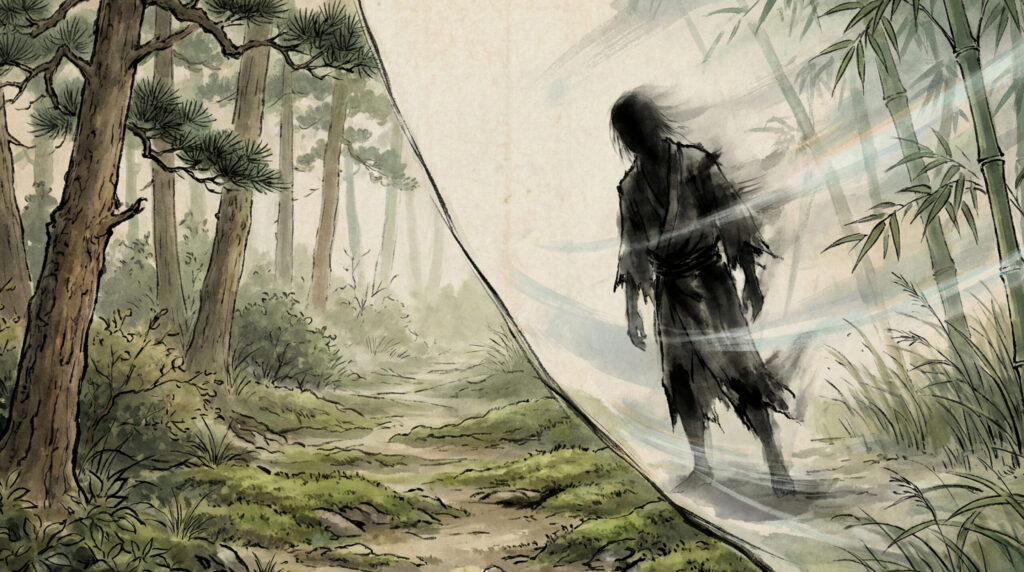
Kekkai yōkai are boundary spirits associated with sacred or restricted space.
They represent invisible lines separating purity, danger, and authority.
Primary Sources
Classical Boundary & Protection Lore
- Engishiki (延喜式) — Boundary purification and protection rites
- Shrine protection manuals and local village talismans
- Yanagita Kunio — Yōkai Dangi
- Komatsu Kazuhiko — Yōkai Encyclopedia
Kekkai Yōkai – Boundary-Dwelling Anomalies in Japanese Folklore
Kekkai Yōkai(結界に棲む怪異) refers to a broad category of supernatural phenomena associated with boundaries, thresholds, and liminal zones in Japanese folklore. Unlike yokai defined by fixed form or personality, kekkai yōkai are characterized by where they appear rather than who they are.
They emerge at points where spaces are divided, protected, or marked: torii gates, shimenawa ropes, crossroads (辻), village borders, bridges, mountain passes, and the edges of ritual grounds. These sites are not merely physical markers, but symbolic interfaces between realms.
The Concept of Kekkai – Sacred Separation
The word kekkai(結界) literally means “tied boundary” or “enclosed demarcation.” In Japanese religious thought, it denotes a space that is ritually separated from ordinary reality.
Kekkai are created to:
- Protect sacred or dangerous zones
- Prevent intrusion by impurity or hostile forces
- Regulate movement between human and non-human realms
Importantly, a kekkai does not erase what lies beyond it. Instead, it acknowledges the presence of something incompatible, allowing coexistence through separation.
Boundary Spaces as Sites of Anomaly
Boundary spaces are inherently unstable. They are neither fully inside nor fully outside, neither sacred nor profane. Japanese folklore consistently treats such zones as sites of heightened supernatural probability.
Typical boundary locations include:
- Torii: entrances to sacred domains
- Shimenawa: ritual ropes marking exclusion
- Crossroads (辻): points of directional ambiguity
- Bridges: connectors between separated spaces
- Village edges and mountain borders: limits of communal control
Kekkai yōkai manifest not because boundaries fail, but because boundaries work—they concentrate tension.
Types of Kekkai Yōkai Phenomena
Kekkai yōkai are not a single species, but a framework encompassing diverse manifestations.
Guardians and Enforcers
Some entities appear to maintain the boundary, driving away intruders or punishing disrespect. These are not benevolent guardians, but functional ones.
Lurkers and Residual Presences
Other phenomena consist of residual forces that gather at boundaries, drawn by constant ritual attention or repeated passage.
Testers of Intent
Certain boundary anomalies respond differently depending on human behavior. Hesitation, arrogance, or impurity may provoke manifestation, while sincerity allows passage.
Relationship to Other Yokai and Spirits
Kekkai yōkai intersect with many established categories without fully belonging to them.
- Yūrei may appear near boundaries but retain personal narratives
- Onryō may be constrained by kekkai rather than generated by them
- Kami preside beyond boundaries, not within them
Kekkai yōkai themselves are often anonymous, lacking names or histories. Their identity is situational, activated by proximity to liminal space.
Symbolism and Cultural Meaning
Fear of the In-Between
Kekkai yōkai embody discomfort with transitional states—moments when orientation fails and categories blur.
Order Through Separation
Rather than erasing danger, Japanese belief often manages it. Kekkai yōkai illustrate a worldview where danger is contained, not destroyed.
Visibility of the Invisible
By marking boundaries physically, communities made invisible forces legible. Kekkai yōkai give form to that legibility.
Related Concepts
Kekkai (結界)
Sacred boundaries separating pure and impure space.
Boundary Guardians
Spirits that mark, protect, or enforce spatial limits.
Liminal Space Spirits
Entities inhabiting thresholds between worlds.
Regional Practices and Variations
Different regions emphasize different boundary types:
- Mountain villages stress forest edges and passes
- Coastal areas focus on shoreline markers
- Urban traditions emphasize bridges, alleys, and crossroads
This variation underscores that kekkai yōkai are landscape-dependent phenomena, shaped by lived geography.
Modern Cultural Interpretations
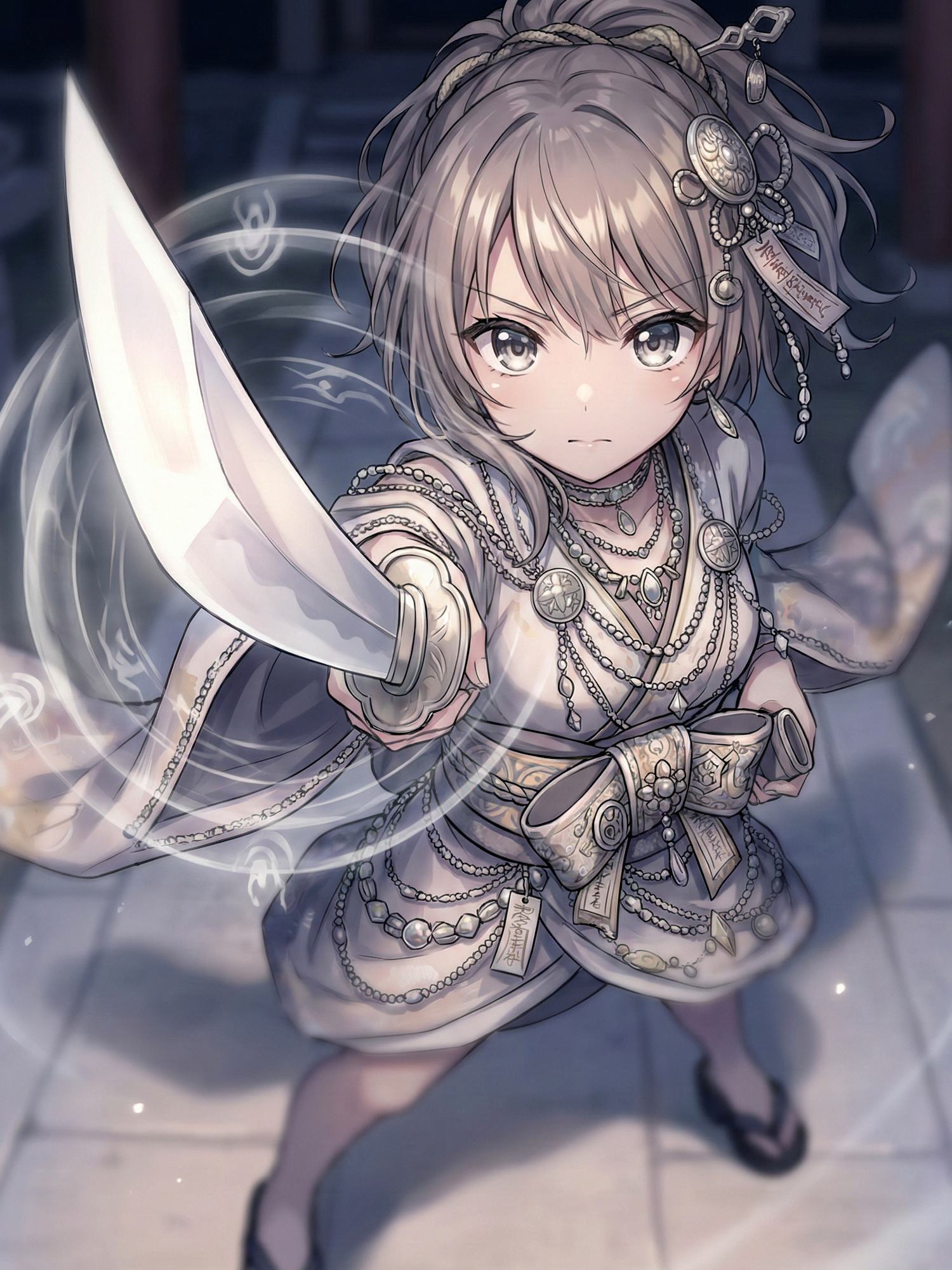
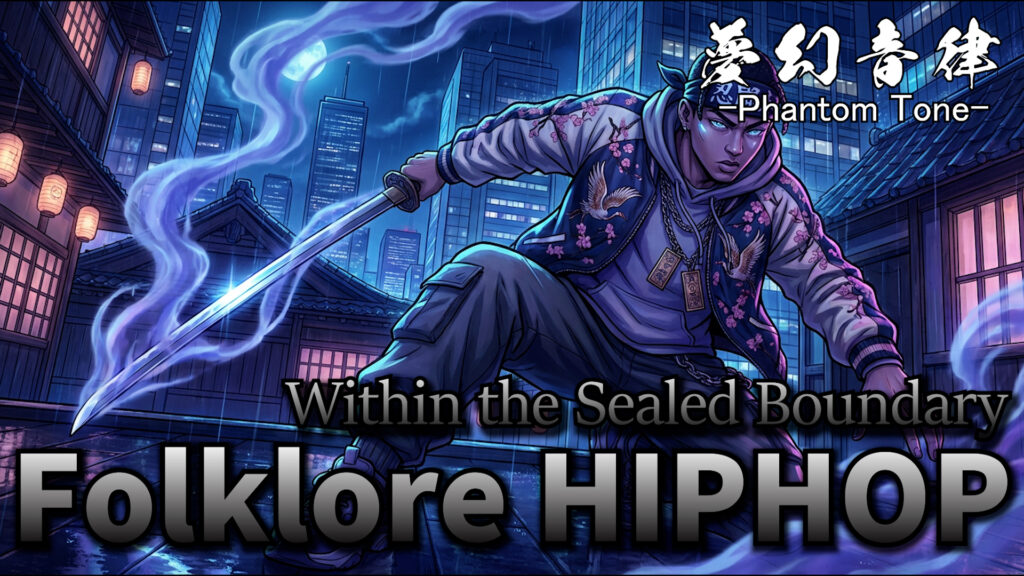
This blade symbolizes spatial prohibition, sacred restriction, and invisible borders.
It visualizes boundaries enforced through unseen spiritual pressure.
In modern contexts, kekkai yōkai are frequently reinterpreted as:
- psychological thresholds,
- social boundaries and mechanisms of exclusion,
- systems that regulate access, permission, and belonging.
These readings closely align with traditional folklore logic. The boundary itself does not vanish — only its justification changes. What was once sacred space may now appear as policy, norm, or unspoken rule.
In some modern visual reinterpretations, kekkai yōkai take the form of a yōtō — a blade that cannot be crossed rather than one that strikes. The sword exists as a line made solid; to draw it is to declare inside and outside, permitted and forbidden. Violence is secondary to separation.
The boundary remains, even if its meaning shifts.
Modern Reinterpretation – Kekkai Yōkai as Contemporary Boundaries
In this reinterpretation, Kekkai yōkai are no longer treated as supernatural guards, but as living boundary systems — invisible mechanisms that regulate belonging, permission, and separation.
Historically, sacred ropes, talismans, and marked lines declared protected space. In modern society, these boundaries have transformed into rules, policies, norms, and unspoken permissions — still unseen, still absolute.
The “beautiful girl” form represents the approachable face of exclusion — gentle, calm, and therefore rarely questioned. She does not threaten. She defines.
Her neutral stance and simplified presence embody thresholds that exist without announcement — zones that silently decide who belongs and who does not.
In this visual reinterpretation, Kekkai yōkai become the personification of structure itself — yokai that exist not to attack, but to separate.
Musical Correspondence
The accompanying track translates boundary tension into sound. Layered textures hover near resolution without crossing it, simulating the experience of approaching a limit.
Gradual builds that halt before climax mirror thresholds that cannot be passed, while silence and pause function as structural gates within the composition.
Together, image and sound form a unified reinterpretation layer — not as folklore illustration, but as a contemporary myth of separation rendered through audiovisual language.

This contemporary form represents silent guardianship and spatial prohibition.
She embodies invisible borders and sacred authority.
Within the Sealed Boundary
Genre: Japanese Folklore Hip-Hop, Ritual Lo-Fi Poetry Produced by: Phantom Tone | Suno AI | Kotetsu Co., Ltd. Tags: #AIgeneratedMusic #JapaneseHipHop #Folklore…
Dreamy and stylish
Genre: Ritual Japanese HipHop / Darkwave Folklore Produced by: Phantom Tone | Suno AI | Kotetsu Co., Ltd. Tags: #JapaneseHipHop #AIgeneratedMusic #Yokai #Phant…