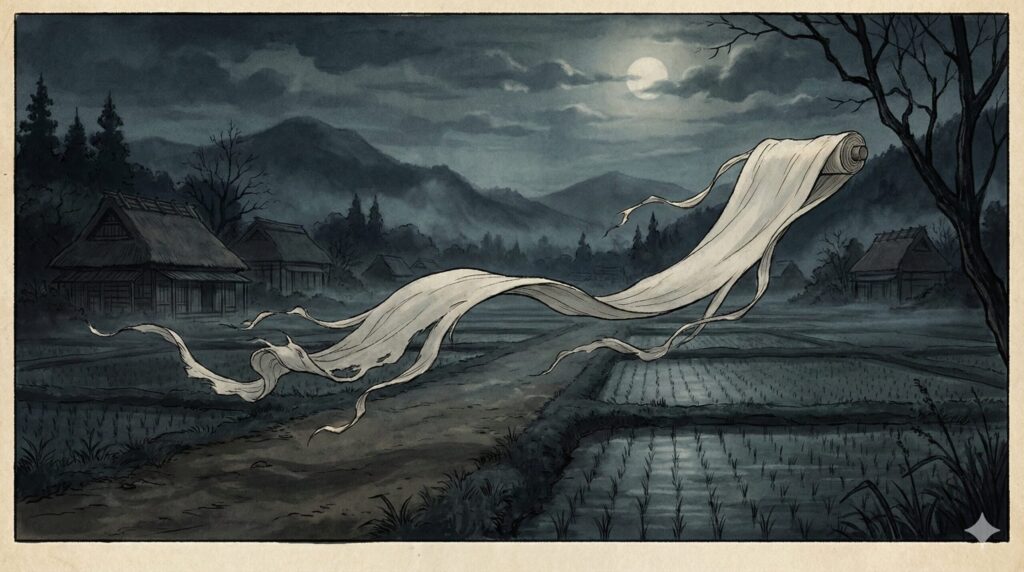
Ittan-momen is a flying cloth yōkai said to entangle travelers at night.
It represents fear of unseen airborne threat and nocturnal roads.
Primary Sources
Edo-Period Illustrated Encyclopedias
- Gazu Hyakki Yagyō (画図百鬼夜行) — Toriyama Sekien
- Konjaku Hyakki Shūi (今昔百鬼拾遺) — Toriyama Sekien
Classical Folklore References
- Yanagita Kunio — Yōkai Dangi
- Komatsu Kazuhiko — Yōkai Encyclopedia
Ittan-momen – Flying Cloth Spirits of Japanese Folklore
Ittan-momen are among the strangest and most unsettling yokai in Japanese folklore: long strips of white cloth that drift silently through the night sky. Neither animal nor humanoid, they appear as animate textiles — simple in form, yet deeply eerie in presence.
Most commonly encountered in rural areas after dark, ittanmomen float on the wind like discarded fabric, only revealing their danger when they suddenly wrap around a person’s face or neck. Their attacks are swift and impersonal, lacking malice or emotion.
Ittan-momen embody the fear of the ordinary turned hostile — the moment when something familiar becomes unrecognizable.
Origins and Early Accounts
Ittan-momen are believed to originate from southern Japan, particularly Kagoshima Prefecture. The name ittan-momen (一反木綿) refers to a standard bolt of cotton cloth, grounding the yokai firmly in everyday material culture.
Early accounts describe white, cloth-like objects flying through the air at night, startling travelers or attacking unsuspecting individuals. In agrarian communities where cotton production and textile use were common, cloth was an intimate part of daily life — making its animation especially disturbing.
These stories likely arose from misidentified natural phenomena such as wind-blown fabric, birds seen in low light, or even optical illusions caused by fatigue and darkness.
From Household Material to Yokai
As folklore solidified, the flying cloth transformed into a defined yokai identity. Unlike spirits born from resentment or curses, ittanmomen lack a clear origin story tied to human emotion.
They do not appear to be former objects imbued with souls, nor vengeful spirits. Instead, they exist as anomalies — disruptions of expectation where inert matter behaves as if alive.
This absence of motive distinguishes ittanmomen from more narrative-driven yokai, emphasizing unease over explanation.
Appearance and Movement
Ittan-momen are typically described as:
Long, white strips resembling cotton cloth
Flat, flexible, and ribbon-like in shape
Capable of silent, gliding flight
Moving erratically with sudden changes in direction
Their simplicity is central to their horror. Without faces, limbs, or voices, they offer no cues for intention. Their motion alone conveys threat.
In some tales, they drift harmlessly until approached, reinforcing the unpredictability of their behavior.
Ittan-momen and the Night Sky
Unlike yokai bound to the ground or water, ittanmomen inhabit the air. They appear on moonlit nights, hovering above roads, fields, or rooftops.
Their aerial nature places them between worlds — not fully of the earth, yet not celestial beings either. This liminal positioning aligns them with moments of vulnerability, when visibility is low and orientation uncertain.
The wind serves not merely as a means of movement, but as an accomplice, carrying the cloth silently toward its target.
Symbolism and Themes
The Uncanny Ordinary
Ittan-momen transform a mundane object into a source of fear, challenging assumptions about safety and familiarity.
Absence of Intent
Unlike yokai driven by desire or resentment, ittanmomen act without discernible purpose, amplifying unease through randomness.
Vulnerability of the Body
Their method of attack — wrapping around the face or neck — targets breath and sight, fundamental human dependencies.
Material Anxiety
As spirits of cloth, ittanmomen reflect anxieties tied to daily tools and materials, suggesting that danger can arise from what surrounds us constantly.
Related Concepts
Flying Yōkai
Aerial yōkai associated with night travel and unseen danger.
Textile & Cloth Spirits
Spirits associated with fabric, clothing, and domestic material culture.
Boundary Crossing Entities
Yōkai that move between sky, road, and village boundaries.
Ittan-momen in Folklore and Art
Ittan-momen appear primarily in regional folklore and later yokai compilations. Their lack of elaborate narrative makes them memorable through image rather than story.
In visual representations, they are often depicted:
Floating against dark night skies
Twisting midair like banners in wind
Wrapping around human figures
Appearing deceptively weightless and calm
These depictions emphasize motion and contrast rather than character.
Regional Variations and Local Beliefs
While most strongly associated with southern Japan, similar flying-cloth phenomena appear in scattered regional accounts.
Local beliefs suggest:
Avoiding walking alone at night
Covering one’s head when sensing movement above
Associating flying cloth with unlucky paths
Interpreting sightings as warnings rather than attacks
These interpretations frame ittanmomen as omens as much as threats.
Modern Cultural Interpretations
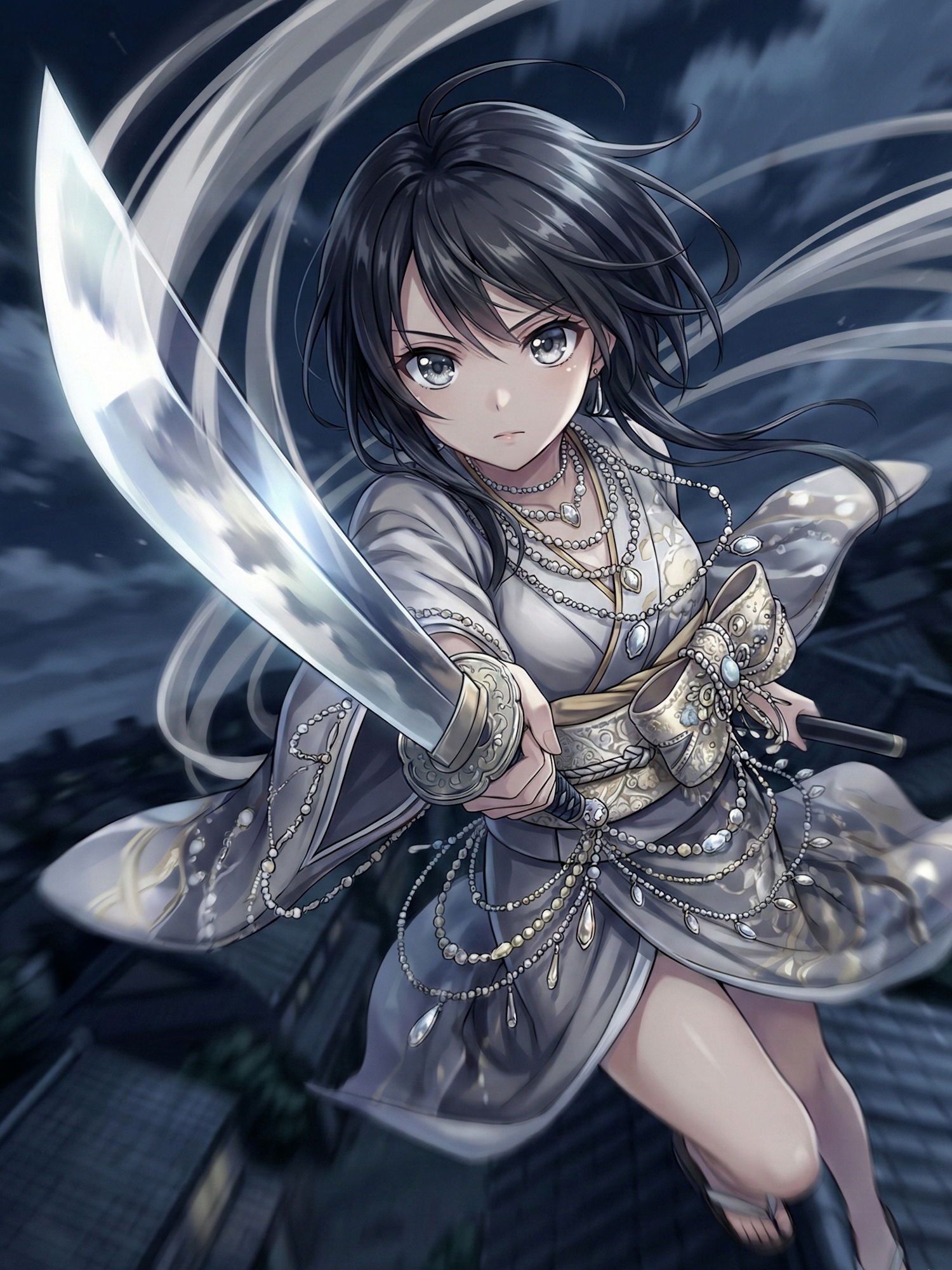
This blade symbolizes suffocation, restraint, and invisible aerial threat.
It visualizes pressure that descends silently from above.
In modern media, ittanmomen are often stylized as eerie yet visually striking entities. Anime and games depict them as swift aerial attackers or as unsettling presences drifting through the background rather than as focal monsters.
Contemporary interpretations frequently lean into abstraction, using ittanmomen as symbols of faceless danger, loss of control, or the sudden animation of systems thought to be inert or harmless.
In some modern visual reinterpretations, ittanmomen take the form of a yōtō — a blade that unfurls rather than swings. The sword’s edge seems to extend like cloth in the wind, wrapping, binding, and cutting simultaneously. Its violence is impersonal, enacted without intent or expression.
Their minimalist design allows for reinterpretation without losing folkloric identity.
Modern Reinterpretation – Ittan-momen as a Contemporary Yokai
In this reinterpretation, Ittan-momen is no longer treated simply as a flying cloth monster, but as a manifestation of instability — the moment when inert objects begin to behave as autonomous systems.
Historically, it appears as an animated bolt of cloth drifting through night air. In modern society, such drifting has transformed into automated processes, impersonal systems, and mechanisms that act without visible intention or accountability.
The “beautiful girl” form represents the familiar surface of these systems — soft, neutral, and therefore trusted. She does not threaten. She operates.
Her flowing silhouette and muted presence embody motion without motive — the quiet disquiet of something that functions without being alive.
In this visual reinterpretation, Ittan-momen becomes the personification of autonomous harm — a yokai that unsettles not through malice, but through function.
Musical Correspondence
The accompanying track translates drifting instability into sound. Floating textures and airy timbres simulate motion without direction, while sudden contractions in rhythm mirror abrupt constriction.
Fluttering motifs and sudden drops into silence evoke unpredictable movement and the choking stillness that follows.
Together, image and sound form a unified reinterpretation layer — not as folklore illustration, but as a contemporary myth of animated systems rendered through audiovisual language.

This contemporary form represents quiet aerial approach and unseen restraint.
She embodies nocturnal danger and boundary-space fear.
Dreamy and stylish
Genre: Ritual Japanese HipHop / Darkwave Folklore Produced by: Phantom Tone | Suno AI | Kotetsu Co., Ltd. Tags: #JapaneseHipHop #AIgeneratedMusic #Yokai #Phant…