
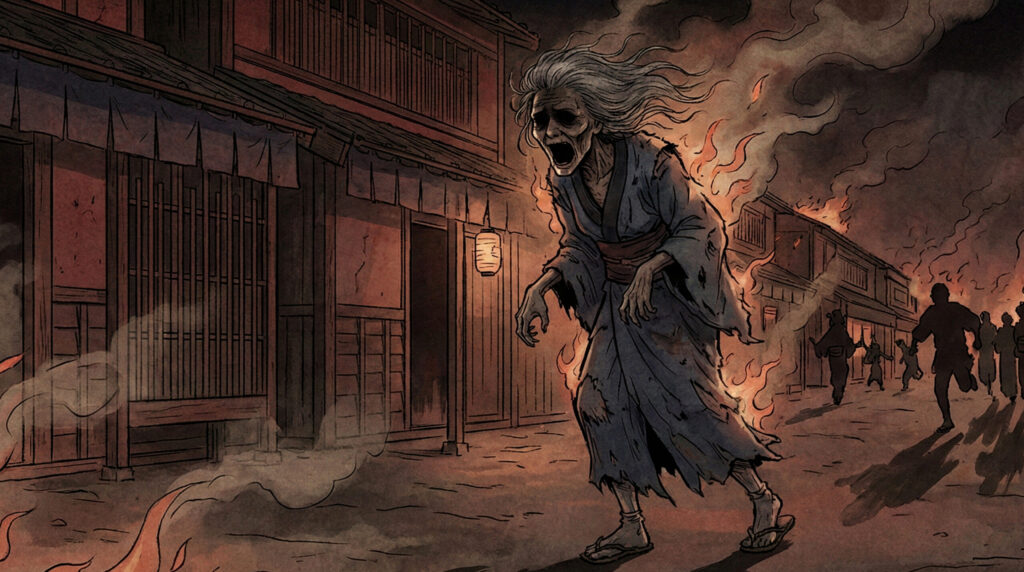
Hikeshi-baba is a yōkai associated with fire, smoke, and domestic disaster anxiety.
She represents fear surrounding household fires and community vigilance.
Primary Sources
Edo-Period Illustrated Encyclopedias
- Gazu Hyakki Yagyō (画図百鬼夜行) — Toriyama Sekien
- Konjaku Hyakki Shūi (今昔百鬼拾遺) — Toriyama Sekien
Classical Folklore References
- Yanagita Kunio — Yōkai Dangi
- Komatsu Kazuhiko — Yōkai Encyclopedia
Hikeshi-baba – Fire-Quenching Spirits of Japanese Folklore
Hikeshi-baba are lesser-known yet symbolically rich figures in Japanese folklore: mysterious old women who appear during fires, extinguishing flames—or in some tales, interfering with human efforts to do so. Their presence is unsettling, blending fear, relief, suspicion, and moral ambiguity. Unlike heroic fire deities or destructive fire demons, hikeshi-baba exist in the narrow, dangerous space between salvation and disruption.
Typically depicted as elderly women with disheveled hair, worn garments, and an uncanny calm amid chaos, hikeshi-baba challenge expectations about age, gender, and power. Fire, one of humanity’s most essential and most dangerous tools, becomes the stage upon which they operate. Whether they are protectors, tricksters, or omens depends on the region, the story, and the interpretation.
Their enduring power lies not in spectacle, but in contradiction: an old woman who masters flame, appears without warning, and vanishes once the crisis passes.
Origins and Early Depictions
The origins of hikeshi-baba are closely tied to premodern urban life, particularly in densely built towns where fire posed a constant threat. Edo-period Japan, with its wooden architecture and crowded streets, produced countless stories about fire-related yōkai, spirits, and omens. Within this environment, the figure of the fire-quenching old woman emerged as both comfort and unease.
Early tales describe hikeshi-baba appearing suddenly at the scene of a blaze, throwing water, chanting, or performing strange gestures that cause flames to subside. In some versions, she is welcomed as a miracle worker. In others, she disrupts organized firefighting efforts, causing confusion or drawing suspicion from onlookers.
These conflicting depictions suggest that hikeshi-baba may not have been conceived as a single fixed entity, but rather as a folkloric category—an explanation for unexpected outcomes during fires, whether fortunate or disastrous.
Fire, Fear, and the Margins of Society
Fire in Japanese folklore is rarely neutral. It represents purification, destruction, divine punishment, and uncontrolled human desire. The figure of an elderly woman intervening in fire carries layered meaning. Older women, particularly those living on the margins of society, were often viewed with a mix of reverence and fear—possessing knowledge, experience, and perceived spiritual sensitivity.
Hikeshi-baba embodies this ambivalence. She may represent communal wisdom that survives outside formal authority, or she may symbolize suspicion toward those who act independently during crisis. Her age contrasts with the violent energy of fire, reinforcing her unnatural authority over it.
In some interpretations, hikeshi-baba are spirits of women who died in fires, lingering between worlds and compelled to intervene when flames reappear.
Appearance and Behavior
Descriptions of hikeshi-baba vary, but recurring elements include:
Elderly female form with weathered features
Loose or ragged clothing, sometimes soaked or scorched
Sudden appearance amid active fires
Minimal or silent communication
Disappearance once the fire subsides
Unlike oni or other aggressive yōkai, hikeshi-baba rarely attack directly. Their influence is subtle but decisive. The fire simply dies—or shifts in ways that defy explanation.
This quiet authority contributes to their unsettling nature. They do not seek recognition, gratitude, or fear. They act, and then they are gone.
Ambiguity of Intent
One of the most striking aspects of hikeshi-baba is the uncertainty surrounding their intent. In some stories, they save homes and lives. In others, they prevent proper fire control, allowing damage to spread. Rarely is their motivation explained.
This ambiguity mirrors the unpredictable nature of fire itself. Just as flames can warm or destroy, hikeshi-baba can protect or hinder. Their presence resists moral simplification, reinforcing a key theme in Japanese folklore: power is not inherently benevolent or malevolent.
Humans must respond with caution rather than assumption.
Symbolism and Themes
Control Over Destruction
Hikeshi-baba represent the unsettling possibility that destruction can be halted—or redirected—by forces outside human systems.
Marginal Wisdom
Their form as elderly women reflects unease toward knowledge that exists beyond institutional authority.
Crisis and Uncertainty
They appear only during moments of danger, embodying the anxiety and confusion that accompany disaster.
Unseen Agency
Their actions suggest that outcomes are not always determined by visible effort alone.
Related Concepts
Fire-Prevention Yōkai
Yōkai associated with domestic fire anxiety and disaster prevention.
Household & Village Yōkai
Domestic spirits rooted in communal order and safety.
Kegare (穢れ)
Spiritual contamination associated with disaster and social disorder.
Regional Variations and Folktales
Local legends across Japan describe variations of hikeshi-baba. Some regions depict her as benevolent, almost saint-like. Others treat her as a warning figure, whose appearance signals future calamity. In a few tales, villagers attempt to follow her, only to lose sight of her in smoke or darkness.
These localized versions reinforce the idea that hikeshi-baba are deeply tied to lived experience—stories shaped by real fires, losses, and inexplicable survivals.
Modern Cultural Interpretations

This blade symbolizes domestic fire anxiety and invisible disaster pressure.
It visualizes vigilance, suppression, and silent danger within household space.
In modern media, hikeshi-baba appear far less frequently than more visually dramatic yōkai. When they do surface, they are often portrayed as eerie background figures — embodiments of disaster memory or suppressed fear surrounding urban catastrophe rather than active antagonists.
Contemporary reinterpretations sometimes shift focus toward themes of disaster response, invisible labor, and generational knowledge. In this framing, hikeshi-baba challenge heroic narratives centered on power and spectacle, instead highlighting endurance, repetition, and unacknowledged responsibility.
In some modern visual reinterpretations, hikeshi-baba manifest as a yōtō — a blade tempered by smoke and ash. The sword does not blaze; it smolders. Its presence signifies containment rather than conquest, bearing the weight of fires prevented, losses remembered, and labor never celebrated.
Hikeshi-baba persist because disasters fade from headlines, but their aftermath never truly ends.
Modern Reinterpretation – Hikeshi-baba as a Contemporary Yokai
In this reinterpretation, Hikeshi-baba is no longer treated as a folkloric anomaly of fire, but as a quiet regulator of disaster — a presence that appears after catastrophe has already begun to settle.
Historically, she emerges without warning, intervenes once, and vanishes. In modern society, such figures take the form of invisible labor, emergency response routines, and unacknowledged systems that stabilize life after crisis.
The “beautiful girl” form represents the domesticated face of restraint — calm, silent, and therefore easily overlooked. She does not confront flame. She governs what remains.
Her subdued posture and neutral tones embody aftermath: the moment when danger has passed, but consequences remain unresolved.
In this visual reinterpretation, Hikeshi-baba becomes the personification of uncelebrated containment — a yokai that holds back collapse without spectacle.
Musical Correspondence
The accompanying track translates restrained authority into sound. Slow, tension-held textures replace explosive crescendos, and distant percussive elements evoke the echo of extinguished flames.
Sudden drops into silence function as structural pauses — suggesting the fragile calm that follows disaster.
Together, image and sound form a unified reinterpretation layer — not as folklore illustration, but as a contemporary myth of quiet containment rendered through audiovisual language.
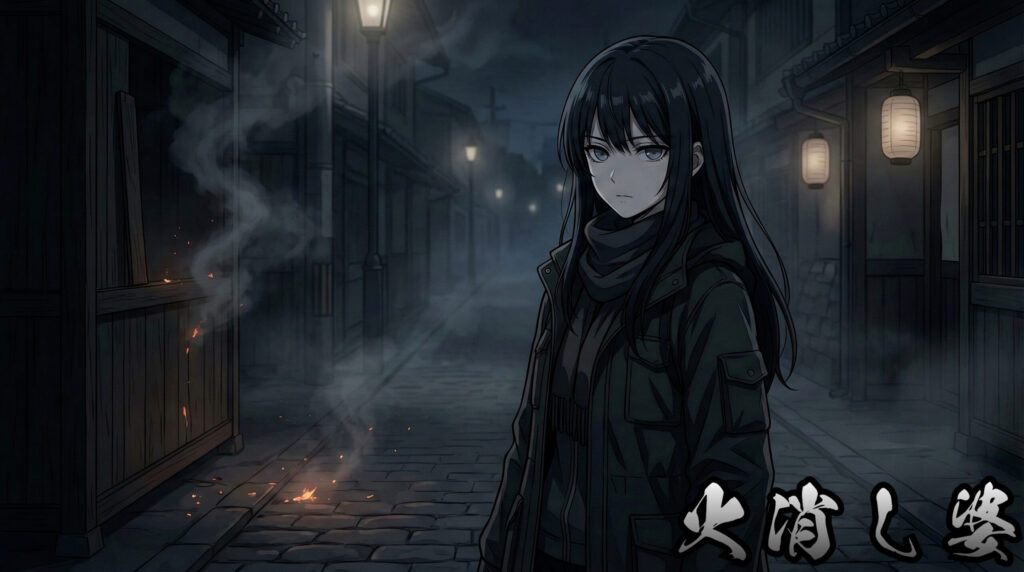
This contemporary form represents vigilance, warning, and unseen domestic threat.
She embodies fire anxiety, community memory, and household disaster fear.
Dreamy and stylish
Genre: Ritual Japanese HipHop / Darkwave Folklore Produced by: Phantom Tone | Suno AI | Kotetsu Co., Ltd. Tags: #JapaneseHipHop #AIgeneratedMusic #Yokai #Phant…