

Azuki-arai is a yōkai known for the sound of washing beans along riversides at night.
It represents fear produced by sound without visible source.
Primary Sources
Edo-Period Illustrated Encyclopedias
- Gazu Hyakki Yagyō (画図百鬼夜行) — Toriyama Sekien
- Konjaku Hyakki Shūi (今昔百鬼拾遺) — Toriyama Sekien
Classical and Regional Folklore Records
- Yanagita Kunio — Yōkai Dangi
- Komatsu Kazuhiko — Yōkai Encyclopedia
Azuki-arai – The Unseen Washer of Beans in Japanese Folklore
Azuki-arai is one of the most enigmatic and quietly unsettling yōkai in Japanese folklore: a small, unseen being said to wash red beans by riversides, mountain streams, or deserted waters at night. Known primarily by sound rather than sight, azuki-arai announces its presence through rhythmic splashing and a distinctive chant, echoing through darkness.
Unlike violent monsters or ominous spirits, azuki-arai rarely causes direct harm. Its power lies in suggestion and unease. The sound of washing beans where no one should be unsettles listeners, drawing attention to places best left alone.
Azuki-arai embodies fear born from sound without source.
Origins and Regional Roots
Legends of azuki-arai are found across various regions of Japan, especially in rural areas where rivers and streams shaped daily life. In these settings, unfamiliar sounds at night demanded explanation.
Azuki-arai emerged as a folkloric answer to such auditory mysteries. The repetitive sound of water striking stones, combined with imagination and darkness, formed the image of a hidden being at work.
Rather than a single mythic origin, azuki-arai represents a shared rural experience—where nature, sound, and superstition converge.
Presence Defined by Sound
Azuki-arai is most often perceived through hearing:
The sound of splashing water
A rhythmic, repetitive motion
A chant resembling bean-counting or washing
Voices asking questions or singing softly
Visual descriptions are rare and inconsistent. When described, azuki-arai may appear as a small humanoid, an elderly figure, or remain entirely unseen. Its identity is secondary to its presence.
This emphasis on sound over sight makes encounters deeply unsettling.
The Call and the Risk
In many stories, azuki-arai calls out to passersby, asking simple questions or chanting phrases such as “Shall I wash them?” Responding—or approaching the sound—can lead to danger.
Those who follow the noise may slip into rivers, fall into ravines, or disappear. Importantly, azuki-arai does not attack. The danger arises from human curiosity and misjudgment.
Silence, avoidance, or refusal to engage is often the safest response.
Liminal Spaces and Nighttime Fear
Azuki-arai is bound to liminal spaces: riverbanks, mountain paths, and borders between villages and wilderness. These are places of transition, where footing is uncertain and visibility limited.
Night amplifies this uncertainty. Sound travels farther, shapes dissolve, and imagination fills gaps. Azuki-arai thrives in these conditions, becoming a manifestation of environmental risk given personality.
Symbolism and Themes
Sound Without Form
Azuki-arai represents fear created by incomplete information.
Curiosity as Danger
The yōkai tests the human impulse to investigate.
Nature’s Indifference
It reflects hazards that exist without intent.
Rural Memory
Its stories encode practical warnings about night travel.
Related Concepts
Auditory Yōkai
Yōkai defined primarily by sound rather than visible form.
Marebito (稀人)
Visitors from beyond whose presence is known before it is seen.
Riverbank & Rural Boundary Spirits
Spirits inhabiting liminal natural spaces.
Azuki-arai in Folklore and Art
In yōkai scrolls and Edo-period illustrations, azuki-arai is sometimes depicted crouching by a stream, rhythmically washing beans. The images are often small and unobtrusive, mirroring the creature’s understated role.
Narratives involving azuki-arai are short and repetitive, reinforcing caution rather than spectacle. The lesson is simple: do not follow strange sounds into darkness.
Modern Cultural Interpretations
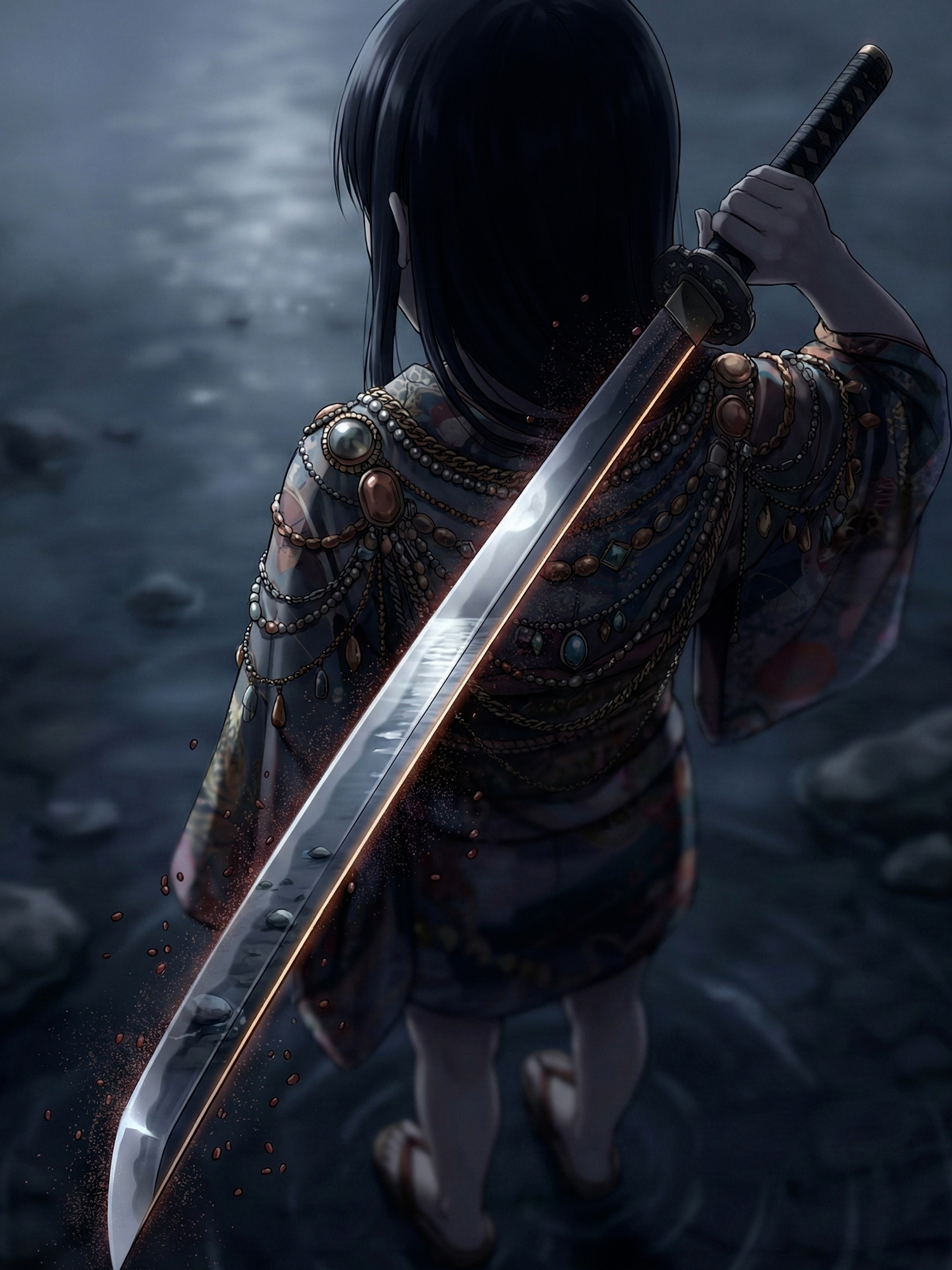
This blade symbolizes unseen presence, auditory anxiety, and fear without visible cause.
It visualizes sound as a trigger for unease and psychological disturbance.
In modern interpretations, Azuki-arai is often read less as a visible creature and more as a phenomenon of unease — a presence defined by sound without source. Contemporary media frequently associates it with psychological horror, where repetition and ambiguity erode a sense of safety.
Psychologically, Azuki-arai is interpreted as a metaphor for compulsive memory, unresolved grief, or rituals that continue long after their original meaning has been forgotten. The act of endlessly washing beans becomes symbolic of minds trapped in circular thought or communities haunted by quiet, unacknowledged loss.
In some modern visual reinterpretations, Azuki-arai manifests as a yōtō — a blade that produces sound rather than force. The sword does not strike immediately; instead, it emits a soft, rhythmic presence that unsettles the wielder before any action occurs. Its danger lies not in violence, but in anticipation.
Azuki-arai endures because unease does not require a face — only repetition.
Modern Reinterpretation – Azuki-arai as a Contemporary Yokai
In this reinterpretation, Azuki-arai is no longer presented as a creature to be seen, but as a lingering acoustic presence — a sound that exists without an identifiable source.
Historically, Azuki-arai is recognized through rhythmic splashing and tapping heard near riversides and abandoned water paths. In modern life, such sounds have transformed into internal echoes: looping thoughts, unresolved memories, and rituals performed long after their meaning has faded.
The “beautiful girl” form functions not as a literal depiction, but as a visual anchor for something fundamentally intangible. She represents the mind’s attempt to assign shape to repetition — a quiet presence that is familiar, unthreatening, and therefore difficult to reject.
Her calm posture and subdued expression reflect a state of suspended attention: not fear, not peace, but anticipation.
In this visual reinterpretation, Azuki-arai becomes a metaphor for the psychological space between sound and action — a yokai that exists entirely within waiting.
Musical Correspondence
The accompanying track translates acoustic unease into sound. Minimal, repeating percussive figures simulate water striking stone, while irregular timing introduces instability without overt disruption.
Sparse melodic fragments drift without resolution, and silence between phrases functions as an active component — suggesting presence through absence.
Together, image and sound form a unified reinterpretation layer — not as folklore illustration, but as a contemporary myth rendered through rhythm, memory, and anticipation.

This contemporary form represents presence detected through sound rather than sight.
She embodies unease, rural liminality, and fear without visible origin.
Dreamy and stylish
Genre: Ritual Japanese HipHop / Darkwave Folklore Produced by: Phantom Tone | Suno AI | Kotetsu Co., Ltd. Tags: #JapaneseHipHop #AIgeneratedMusic #Yokai #Phant…