
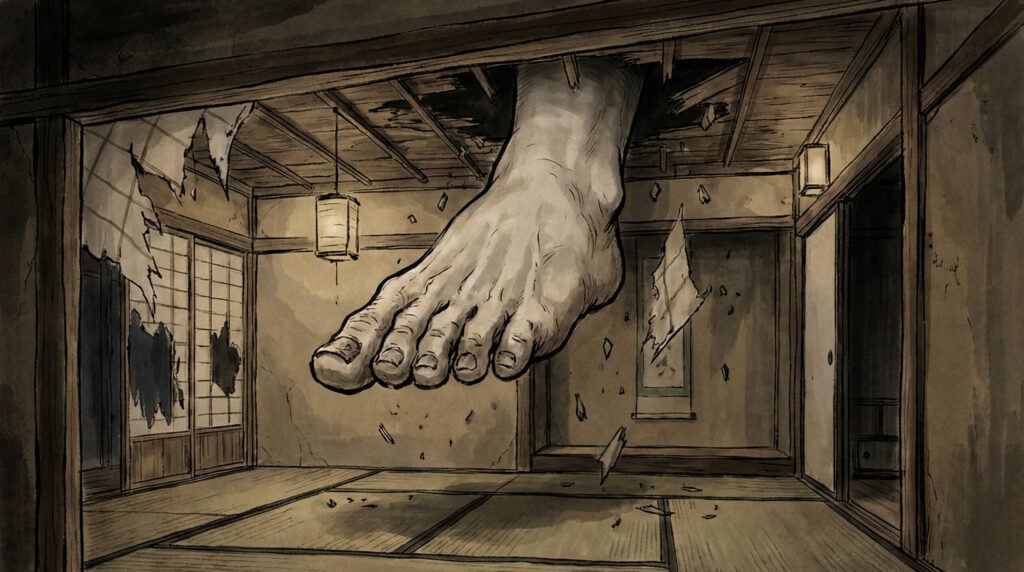
Ashiarai Yashiki is a mysterious household phenomenon in which a giant, disembodied leg appears from the ceiling demanding to be washed.
It represents domestic fear, social obligation, and unseen authority within private space.
Primary Sources
Edo-Period Illustrated Encyclopedias
- Gazu Hyakki Yagyō (画図百鬼夜行) — Toriyama Sekien
- Konjaku Hyakki Shūi (今昔百鬼拾遺) — Toriyama Sekien
Classical and Folklore References
- Yanagita Kunio — Yōkai Dangi
- Komatsu Kazuhiko — Yōkai Encyclopedia
Ashiarai Yashiki – The House That Forces the Living to Serve an Invisible Presence in Japanese Folklore
Ashiarai Yashiki is a household yōkai phenomenon in which a gigantic, unseen foot suddenly thrusts down from the ceiling or upper space of a house, demanding to be washed. The house becomes a site of compulsory service to something that cannot be seen, confronted, or removed.
Nothing enters.
Nothing explains itself.
The house issues a command.
Ashiarai Yashiki embodies domination without appearance.
Origins in Household Fear and Vertical Space
Traditional Japanese houses emphasized horizontal movement, yet their ceilings concealed darkness: rafters, lofts, unused storage, and symbolic “upper” space associated with the unknown.
Ashiarai Yashiki emerges from anxiety surrounding this vertical blind spot. The foot descends from above—where humans cannot see or reach—transforming the house from shelter into obligation.
The threat does not invade.
It asserts itself.
From Sound to Command
Where Yanari announces presence through sound, and Tokakushi denies passage through absence, Ashiarai Yashiki escalates to direct demand.
The house no longer hints.
It orders.
This marks a shift from passive uncanny to enforced interaction.
Appearance: The Partial Body
Accounts of Ashiarai Yashiki consistently emphasize incompleteness:
A massive human foot
Covered in filth or mud
Descending abruptly from the ceiling
No body attached, no origin visible
The lack of a whole form denies identity. The phenomenon is not a being—it is a function.
Only the demand manifests.
Behavior: Compulsory Service
Ashiarai Yashiki operates through coercion rather than violence:
The foot remains until washed
Resistance escalates pressure or fear
Compliance causes immediate withdrawal
The event ends without explanation
The household is forced into ritual labor.
Obedience restores order.
Relationship with Residents
Folklore emphasizes that households affected by Ashiarai Yashiki are not cursed randomly. Contributing factors often include:
Neglect of the home
Moral imbalance within the household
Disrespect toward unseen forces
Accumulated impurity
The phenomenon corrects through enforced humility.
The house demands acknowledgment.
Ashiarai Yashiki in Household Ontology
Within domestic yōkai taxonomy, Ashiarai Yashiki occupies a distinct tier:
- Yanari – the house signals
- Tokakushi – the house refuses
- Ashiarai Yashiki – the house commands
- Tsukumogami – the house awakens objects
It represents domestic authority turned absolute.
Symbolism and Themes
Forced Ritual
Action without belief.
Vertical Authority
Power descends from above.
Fragmented Entity
Command without identity.
Service as Restoration
Order resumes through submission.
Related Concepts
Household & Village Yōkai
Domestic yōkai associated with private space, obligation, and social anxiety.
→ Household Yokai Index
Kegare (穢れ)
Pollution and defilement as moral and spiritual contamination.
Invisible Authority
Unseen power that imposes obligation without visible source.
Ashiarai Yashiki in Folklore Records
The tale appears in Edo-period yōkai catalogs, often without regional variation, suggesting its function as a conceptual extreme rather than local legend.
The lack of narrative detail is intentional. What matters is not who demands service—but that service is unavoidable.
The house becomes the shrine.
Modern Cultural Interpretations

This blade symbolizes invisible authority and forced domestic obligation.
It visualizes commands that arrive without source, explanation, or negotiation.
Modern interpretations often view Ashiarai Yashiki as a metaphor for invisible systems of obligation — demands imposed without explanation, authority, or accountability.
Psychologically, it reflects anxiety toward arbitrary labor and compliance enforced by environment: the sense that one must keep responding, keep cleaning, keep obeying, even when the source of the demand cannot be confronted.
In some modern visual reinterpretations, Ashiarai Yashiki is expressed as a yōtō — a blade that “orders” rather than attacks. The sword carries a compulsive command: if it is drawn, something must be done, something must be cleaned, something must be paid back. Its curse is not violence, but endless compliance.
Ashiarai Yashiki persists because people still live under unseen demands.
Modern Reinterpretation – Ashiarai Yashiki as a Contemporary Yokai
In this reinterpretation, Ashiarai Yashiki is no longer treated simply as a haunted house, but as an architectural system of command — a space that enforces obedience without explanation.
Historically, the phenomenon appears as a gigantic foot descending from the ceiling, demanding water for cleansing. In modern life, however, such “feet” no longer appear as monsters, but as invisible systems: procedures, routines, obligations, and compliance mechanisms embedded into everyday environments.
The “beautiful girl” form represents the domesticated face of this authority — calm, approachable, and therefore unquestioned. She does not threaten. She issues necessity.
Her quiet presence reflects how commands are normalized: tasks that must be done, debts that must be paid, and corrections that must be performed — without any visible ruler.
In this visual reinterpretation, Ashiarai Yashiki becomes the personification of structural obedience — a yokai that rules not by terror, but by routine.
Musical Correspondence
The accompanying track translates inevitability into sound. Heavy downbeats establish a sense of descending authority, while abrupt interruptions simulate the intrusion of command into daily rhythm.
Repetitive, constrained motifs reflect forced labor — cycles that only resolve after compliance is complete.
Together, image and sound form a unified reinterpretation layer — not as folklore illustration, but as a contemporary myth of command rendered through audiovisual structure.
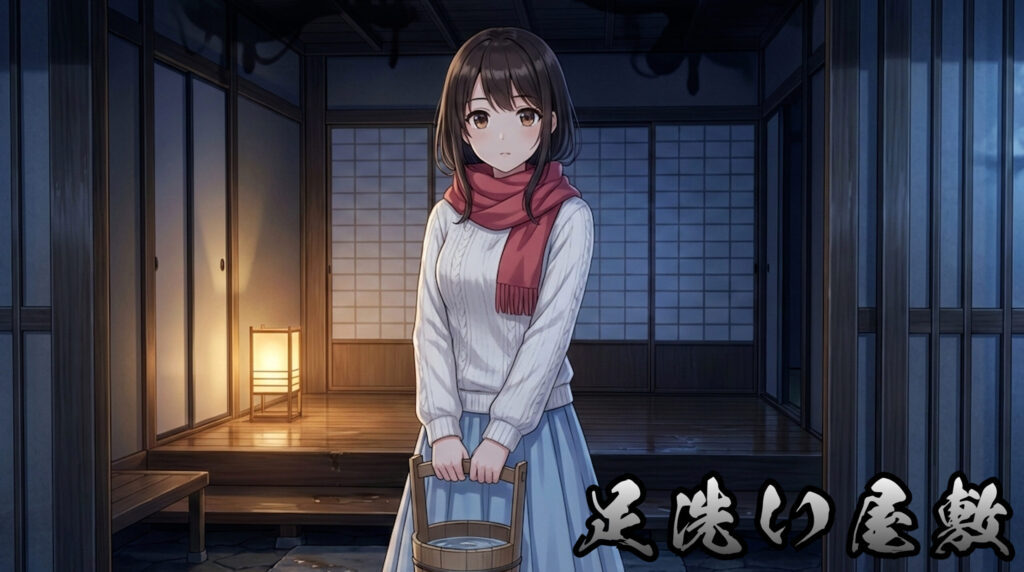
This contemporary form embodies sudden intrusion, unreasonable demand, and silent domestic fear.
She represents authority without face, and obligation without consent.
Dreamy and stylish
Genre: Ritual Japanese HipHop / Darkwave Folklore Produced by: Phantom Tone | Suno AI | Kotetsu Co., Ltd. Tags: #JapaneseHipHop #AIgeneratedMusic #Yokai #Phant…