Hōō – Celestial Phoenix of Japanese Myth and Legend
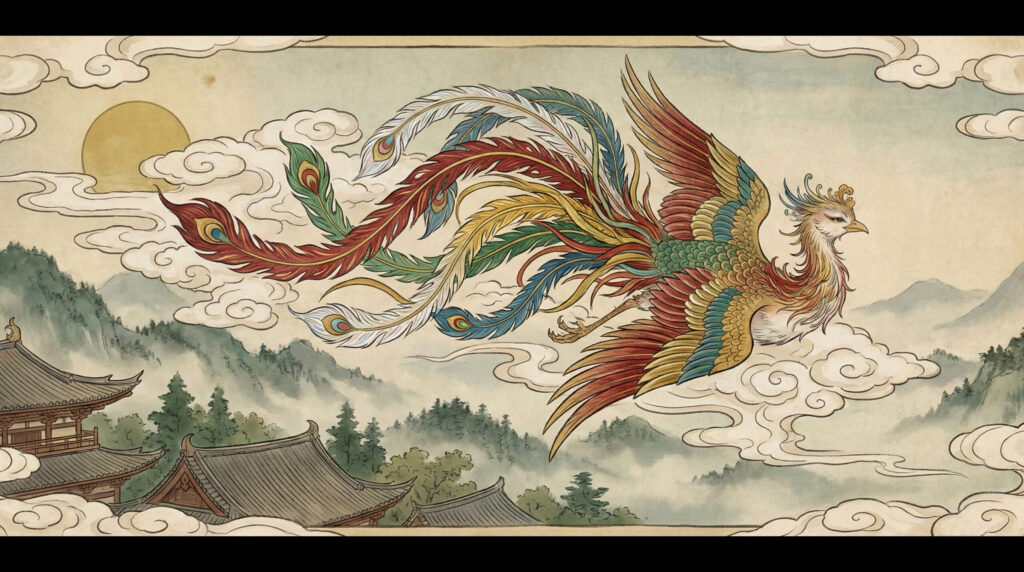
The Hōō, often translated as the Japanese phoenix, is one of the most exalted and symbolic beings in Japanese mythology. Unlike destructive monsters or mischievous yōkai, the hōō represents harmony, virtue, renewal, and cosmic balance. It is not a creature of fear, but of omen—its appearance signaling an age of peace, just rule, and moral order.
Depicted as a magnificent, otherworldly bird adorned with radiant plumage, the hōō embodies an ideal rather than a threat. It is said to appear only in times of harmony and to vanish when disorder or corruption prevails. As such, the hōō exists less as an active agent and more as a cosmic barometer, reflecting the moral state of the world.
In Japanese culture, the hōō stands at the intersection of mythology, political symbolism, and spiritual aspiration.
Origins and Transmission to Japan
The hōō originates from the Chinese fenghuang, a mythological bird associated with imperial virtue and cosmic harmony. Introduced to Japan through early cultural exchange, particularly during the Asuka and Nara periods, the concept was absorbed into Japanese cosmology and adapted to local beliefs.
While rooted in continental mythology, the Japanese hōō developed its own distinct identity. Rather than being directly worshipped as a deity, it became a symbolic presence—appearing in art, architecture, and court ideology as a sign of divine approval and righteous governance.
In classical texts, the hōō is described as a composite creature, combining elements of multiple animals: the beak of a rooster, the neck of a snake, the back of a tortoise, and the tail of a fish. This hybrid form reinforces its role as a unifying being that transcends ordinary categories.
Appearance and Sacred Attributes
Descriptions of the hōō emphasize beauty, symmetry, and balance rather than aggression:
Brilliant, multicolored feathers often associated with fire and sunlight
Graceful wings capable of traversing heaven and earth
A noble, serene expression rather than ferocity
A presence accompanied by light, music, or auspicious clouds
The hōō is frequently depicted standing calmly rather than in flight, suggesting stability and restraint. It does not hunt, kill, or consume living beings, instead subsisting on bamboo seeds or sacred dew—an image reinforcing its purity and nonviolence.
Symbol of Peace and Virtuous Rule
A central theme of hōō mythology is its relationship to governance. The bird is said to appear only under the reign of a wise and benevolent ruler. Its arrival signifies harmony between heaven, earth, and humanity, while its absence or disappearance warns of moral decay.
Because of this association, the hōō became a powerful emblem in imperial symbolism. It appears on ceremonial objects, court decorations, and later architectural motifs, most famously atop the Phoenix Hall (Hōō-dō) at Byōdō-in Temple.
In this context, the hōō functions not as a supernatural actor, but as a judgment rendered by the cosmos itself.
Fire, Renewal, and Misconceptions
Unlike the Western phoenix, which is defined by death and rebirth through flame, the Japanese hōō is less focused on cyclical destruction. While fire and radiance are part of its imagery, they symbolize illumination and vitality rather than self-immolation.
Renewal in hōō mythology is moral and societal rather than physical. The world is “reborn” not through catastrophe, but through the restoration of harmony and virtue. This distinction reflects broader differences between Japanese and Western mythic structures.
Symbolism and Themes
Harmony Over Conflict
The hōō represents balance, coexistence, and the alignment of human conduct with cosmic order.
Moral Authority
Its appearance serves as an external validation of ethical leadership and righteous rule.
Transcendence of Duality
As a composite being, the hōō transcends simple categories of animal, spirit, or deity.
Idealized Power
Its strength lies in presence and symbolism, not action or domination.
Hōō in Art and Cultural Memory
Throughout Japanese history, the hōō has been a favored motif in visual art, architecture, and decorative crafts. It appears in temple carvings, folding screens, kimono patterns, and imperial regalia.
Rather than dynamic action scenes, artists tend to depict the hōō in poised, symmetrical compositions, reinforcing its association with order and serenity. Its image became synonymous with refinement, prosperity, and spiritual legitimacy.
Even in modern Japan, the hōō remains a symbol of elegance and auspiciousness, frequently invoked in ceremonial or commemorative contexts.
Modern Interpretations
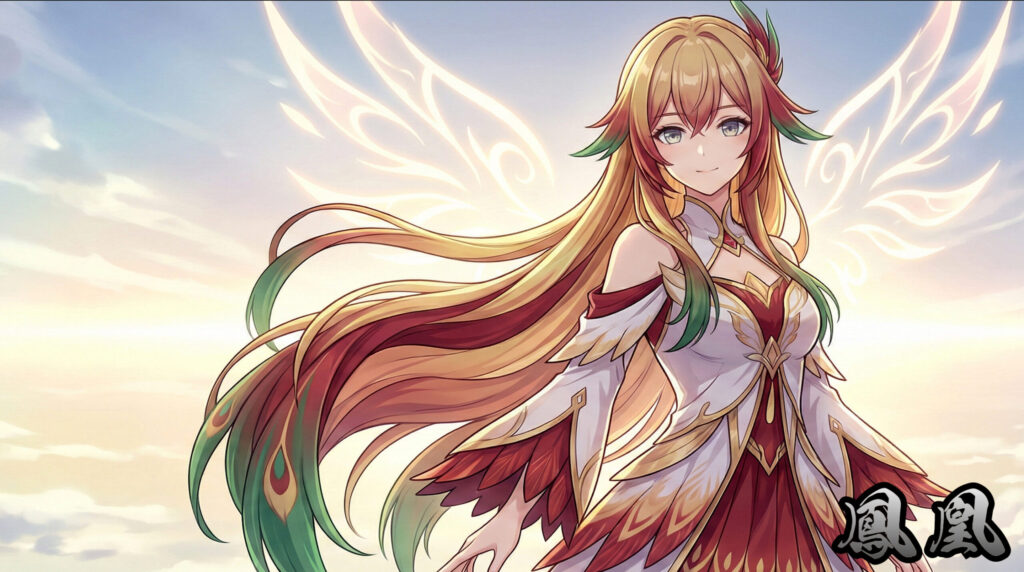
In contemporary media, the hōō is often reimagined through fantasy, animation, and game design as a majestic, radiant being associated with healing, rebirth, or ultimate balance. While modern interpretations may incorporate more dramatic elements, the core symbolism of harmony and moral authority remains intact.
Unlike darker mythological creatures, the hōō is rarely portrayed as antagonistic. Instead, it functions as an aspirational figure—a reminder of an ideal world rather than a reflection of human fear.
Conclusion – Hōō as the Bird of Cosmic Balance
The hōō stands apart from most figures in Japanese folklore. It does not haunt, deceive, or punish. Instead, it observes, reflects, and judges silently. Its presence marks alignment between human society and the greater order of the universe.
As a symbol, the hōō embodies the hope that power can exist without violence, authority without oppression, and renewal without destruction. It is a vision of harmony made visible—a myth not of fear, but of aspiration.
Music Inspired by Hōō (Phoenix)
Music inspired by the hōō often emphasizes spaciousness, clarity, and gradual ascent. Long, sustained tones and flowing melodic lines can evoke the bird’s serene flight through sky and cloud.
Layered harmonies, slow harmonic progressions, and luminous textures reflect balance rather than conflict. Percussion, if present, is restrained and ceremonial, suggesting dignity instead of urgency.
By focusing on elegance, restraint, and radiant stillness, music inspired by the hōō captures its essence not as a creature of flame and destruction, but as a living symbol of harmony, renewal, and ideal order.
Dreamy and stylish
Genre: Ritual Japanese HipHop / Darkwave Folklore Produced by: Phantom Tone | Suno AI | Kotetsu Co., Ltd. Tags: #JapaneseHipHop #AIgeneratedMusic #Yokai #Phant…
 Phantom Tone – Japanese Folklore Hip-Hop Project