
Dojikiri Yasutsuna – Legendary Japanese Yokai Sword Orthographic Reference
 phant0m_wp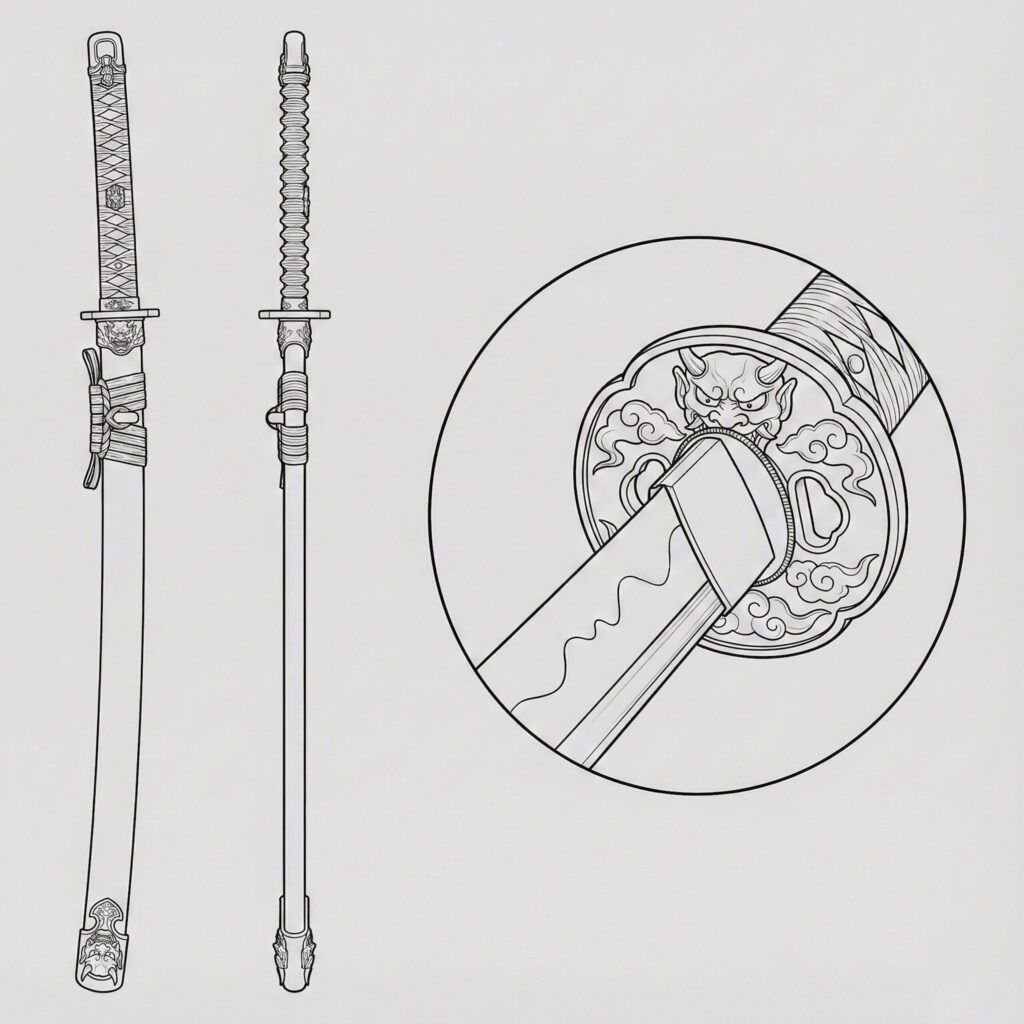
Folklore Episode – Dojikiri Yasutsuna
Dojikiri Yasutsuna is the most narratively “complete” of Japan’s Five Great Swords, firmly anchored in the Shuten Dōji legend.
Unlike swords remembered mainly as heirlooms, Dojikiri is remembered as a decisive object — the blade that ends a threat rather than merely containing it.
In the tale, Minamoto no Yorimitsu infiltrates Mount Ōe and defeats the oni Shuten Dōji through deception and timing rather than brute force alone.
Dojikiri becomes the instrument of final separation — the moment where monstrous power is no longer an abstract danger but a severed presence.
Folklorically, this gives the sword a unique symbolic position.
It represents resolution: the closing of a supernatural crisis.
Where many sacred objects promise protection, Dojikiri embodies completion — the idea that certain evils can be ended rather than merely managed.
This makes Dojikiri culturally important beyond myth.
It reinforces a social model in which authority, ritual, and planning are valued above reckless heroism.
The blade does not glorify chaos; it legitimizes order.
Because of this, Dojikiri Yasutsuna persists not simply as a weapon, but as a cultural statement:
some dangers are not meant to be lived with — they are meant to be finished.