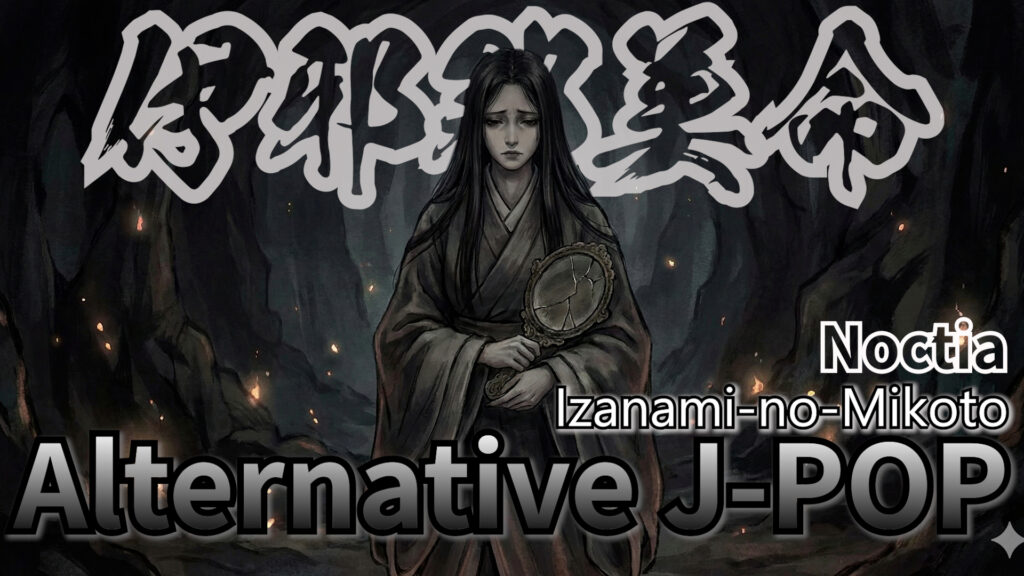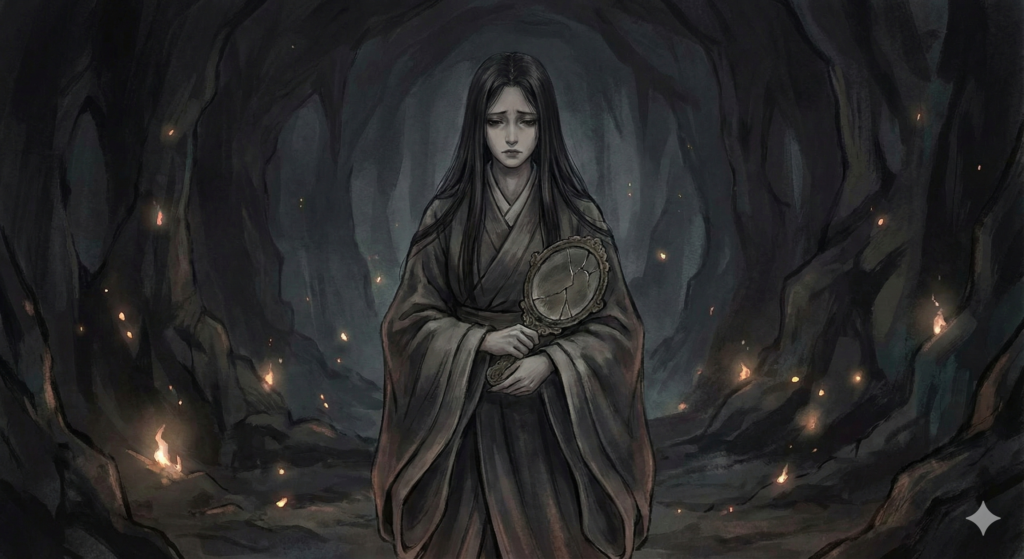
In the ancient cosmology of Japan, Izanami-no-Mikoto stands as one of the most foundational and formidable deities—both the Mother of Creation and the embodiment of the boundary between life and death. She is not merely a mythic figure; she is the axis around which Japan’s earliest notions of cosmos, mortality, purification, and divine authority revolve. Her story, documented in the Kojiki and Nihon Shoki, forms the structural backbone of Japanese mythology itself.
Together with her consort Izanagi-no-Mikoto, Izanami is said to have shaped the islands of the archipelago, giving birth to mountains, rivers, seas, and the myriad gods that govern them. Her creative power is unparalleled—every part of nature, from the roaring oceans to the quiet hearth, was touched by her generative force. Yet the myth of Izanami is not solely a hymn of creation; it is equally a descent into the darkness of loss, sorrow, and the irreversible divide between the realms of the living and the dead.
Her death during the birth of Kagutsuchi, the fire deity, marks one of the most thematically significant moments in Japanese cosmology. It introduces the concepts of defilement, ritual purity, and the spiritual dangers inherent in crossing forbidden thresholds. Izanagi’s desperate journey to Yomi—the shadowed land of the dead—in search of his lost wife establishes the earliest narrative of taboo, transgression, and the absolute laws governing the natural order. Izanami, transformed by death, becomes a fearsome presence whose authority extends over decay, darkness, and the inevitability of mortality itself.
This duality—creator and destroyer, mother and avenger—gives Izanami-no-Mikoto a distinctive place among the world’s mythological figures. She is not a passive goddess of loss; she is an active cosmic force whose declaration upon parting from Izanagi— that she would take one thousand lives each day—frames the Japanese understanding of death as a constant, rhythmic truth woven into existence. Only Izanagi’s counter-vow to create fifteen hundred lives daily balances the cosmic scales. Their conflict becomes the metaphysical origin of human mortality.
Because of this profound narrative weight, Izanami-no-Mikoto is often interpreted as the embodiment of elemental inevitability: the cycle of life and death, the fire that gives birth but also consumes, the shadow that mirrors the light, and the sacred impurity that necessitates cleansing rituals in Shinto practice. Her presence reverberates in ancient funerary customs, purification rites (misogi), and the broader Japanese worldview where creation and destruction coexist as inseparable forces.
Modern reinterpretations of Izanami often highlight her tragic dignity and unyielding authority—an archetype of the divine feminine who transcends the conventional boundaries between nurturing creation and overwhelming cosmic power. Within contemporary art, music, and cultural revival movements, she continues to inspire narratives that explore loss, rebirth, and the haunting beauty of divine inevitability.
Music Inspired by Izanami-no-Mikoto
Below is a curated selection of musical works that reinterpret the emotional and symbolic core of Izanami-no-Mikoto—her timeless power, sorrow, and cosmic duality—through modern alternative Japanese pop aesthetics.
Izanami-no-Mikoto
Genre: Alternative j-pop / Japanese Mythology Pop / AI-generated Music Produced by: Noctia | Suno AI | Kotetsu Co., Ltd. Tags: #JapaneseMythology #AlternativeJ…
 Noctia | Alternative J-POP Collective