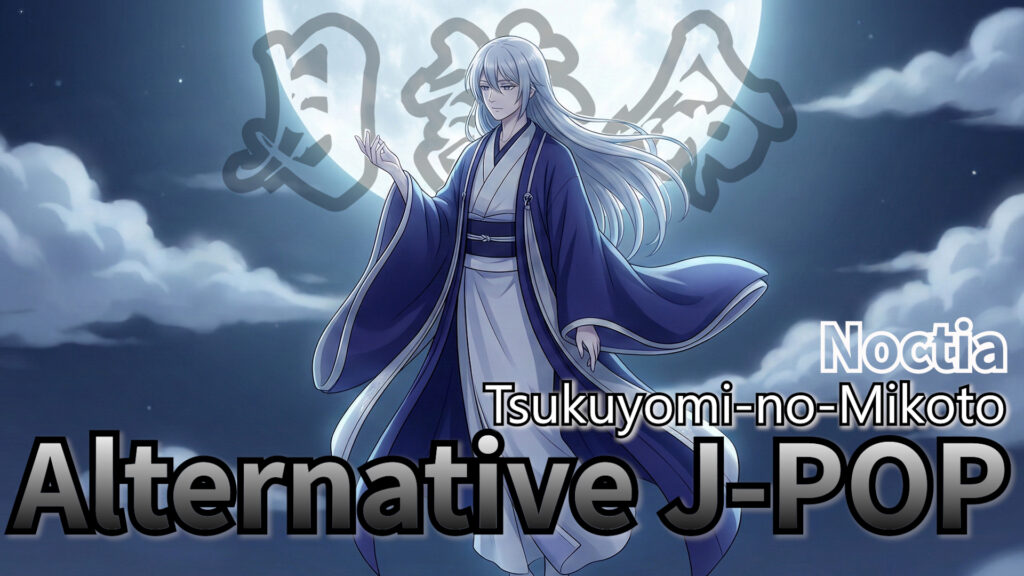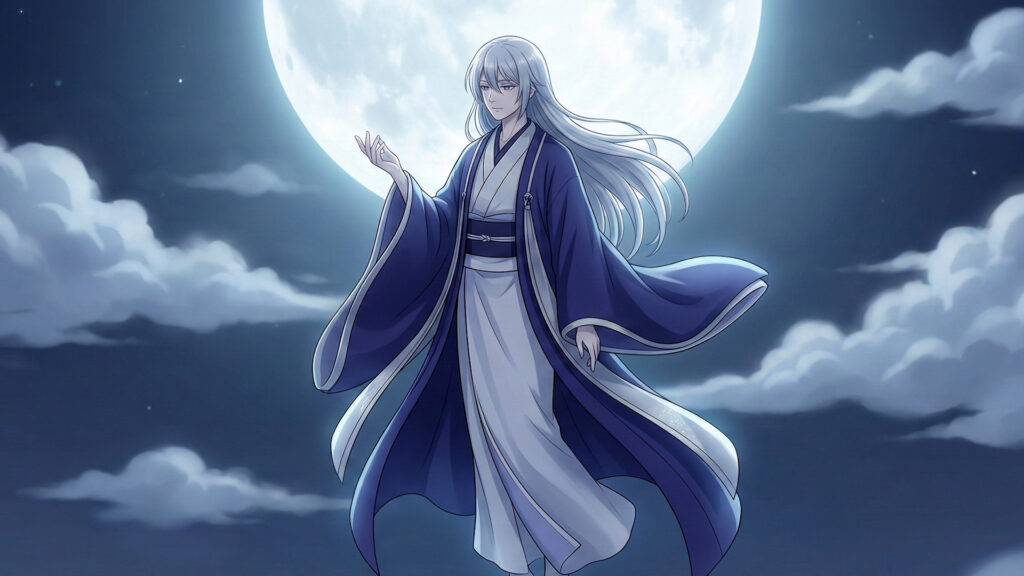
Tsukuyomi-no-Mikoto — The Silent Axis of Night and Moral Order
In the ancient cosmology of Japan, Tsukuyomi-no-Mikoto occupies a uniquely paradoxical position: a primordial deity whose influence is vast, yet whose presence in myth is defined by silence, distance, and rupture rather than creation or abundance. As the god of the moon and the night, Tsukuyomi is not merely a celestial figure governing time and tides; he embodies the moral tension, separation, and irreversible boundaries that underpin early Japanese conceptions of cosmic order.
Born from the same divine act as Amaterasu-Ōmikami and Susanoo-no-Mikoto, Tsukuyomi stands at the heart of the most foundational triad in Shinto mythology. Yet unlike his radiant sister, whose authority is reaffirmed through continuity and worship, or his tempestuous brother, whose chaos fuels narrative momentum, Tsukuyomi’s mythic role is defined by withdrawal. His presence is essential—but it is an essential absence, shaping the cosmos through separation rather than action.
The defining moment of Tsukuyomi’s myth occurs during the sacred banquet of Uke Mochi, the goddess of food. Repulsed by her method of creation—producing sustenance from her own body—Tsukuyomi kills her in an act that is both moral judgment and cosmic transgression. This act fractures the divine order irreversibly. Amaterasu, appalled by Tsukuyomi’s violence, severs all ties with him, decreeing that they shall never again share the same sky. From this divine estrangement arises the eternal alternation of day and night.
This separation is not merely astronomical; it is ethical and symbolic. Tsukuyomi becomes the embodiment of moral absolutism and its consequences—the god who acts according to an uncompromising sense of purity, yet is condemned to isolation for doing so. In this sense, Tsukuyomi represents one of the earliest mythological explorations of justice without compassion, order without empathy, and the loneliness that results from rigid adherence to principle.
Unlike Izanami, whose descent into Yomi transforms her into an active force of death and vengeance, Tsukuyomi’s power manifests through stillness and distance. He does not rule the underworld, nor does he nurture life. Instead, he governs cycles—time, reflection, restraint. The moon does not generate light; it reflects it. This cosmological detail becomes central to Tsukuyomi’s symbolism: he is authority without creation, visibility without warmth, presence without voice.
Because of this, Tsukuyomi is often interpreted as the deity of boundaries—between day and night, purity and defilement, action and consequence. His myth reinforces the Shinto understanding that certain transgressions cannot be purified away, only acknowledged and endured. The night exists not as a space of evil, but as a necessary counterbalance—a realm where judgment lingers and reflection replaces movement.
In ritual and cultural memory, Tsukuyomi’s influence is subtle but pervasive. Lunar cycles governed agricultural rhythms, ceremonial timing, and spiritual observance. The moon’s quiet dominance over tides and seasons echoes Tsukuyomi’s mythic role: unseen control rather than overt command. Where Amaterasu legitimizes imperial authority through light and continuity, Tsukuyomi reinforces cosmic law through separation and consequence.
Modern interpretations often reclaim Tsukuyomi as a tragically dignified figure—a god condemned not for chaos, but for certainty. In contemporary art, music, and alternative Japanese pop narratives, Tsukuyomi inspires themes of solitude, emotional restraint, moral ambiguity, and the quiet weight of irreversible choice. He resonates deeply with modern sensibilities that recognize the cost of absolute judgment and the loneliness of standing apart from the world one governs.
Ultimately, Tsukuyomi-no-Mikoto stands as the silent axis of night, a deity whose power lies not in creation or destruction, but in the immutable truth that some divisions, once made, define the rhythm of existence forever. The moon’s journey across the sky is thus not a tale of illumination, but of distance—a reminder that harmony in the cosmos is often born not from unity, but from separation.
Tsukuyomi-no-Mikoto
Genre: Alternative j-pop / Japanese Mythology Pop / AI-generated Music Produced by: noctia | Suno AI | Kotetsu Co., Ltd. Tags: #Tsukuyomi #JapaneseMythology #A…
 Noctia | Alternative J-POP Collective